1. The Science of the Sensitive Period for Language
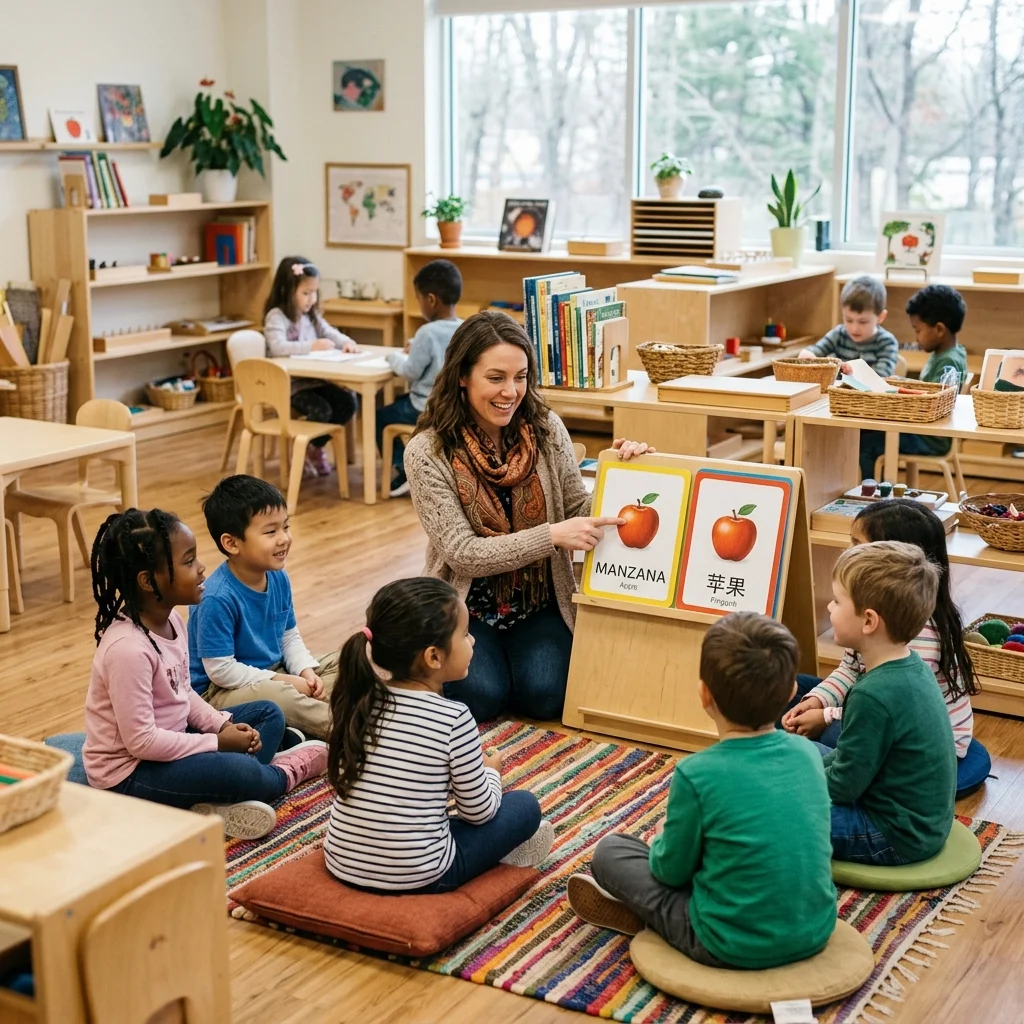
Dr. Maria Montessori identified what neuroscientists now confirm through brain imaging: children experience a sensitive period for language acquisition from birth through approximately age 6. During this window, the brain's neural pathways for phonological processing are highly plastic. A child effortlessly absorbs sound patterns, grammar structures, and vocabulary from their environment without conscious effort.
After age 6, language acquisition shifts from unconscious absorption to deliberate study. The child who begins learning Mandarin at age 8 must consciously memorize tones and grammar rules. The child who was immersed in Mandarin at age 2 has already internalized those tones as naturally as their native language. The difference in fluency outcomes — and crucially, the difference in accent — is dramatic and well-documented in peer-reviewed neurolinguistic research.
This is why we consider the bilingual component of our language immersion program non-negotiable for families who want to give their child a genuine cognitive and linguistic edge.

2. Cognitive Benefits That Go Beyond Language
Decades of research from the University of California, Harvard, and York University in Toronto converge on one finding: bilingual children are cognitively different from monolingual children in measurable, advantageous ways. The constant management of two language systems — deciding which language to use, suppressing the other, switching contexts — functions as daily exercise for the brain's executive function network.
The documented cognitive advantages of bilingual preschool include:
- Superior attention control — bilingual children are better at filtering distractions
- Enhanced working memory — holding multiple pieces of information simultaneously
- Greater cognitive flexibility — the ability to switch between tasks and rule sets
- Earlier theory of mind development — understanding that others hold different perspectives
- Delayed cognitive aging — bilingualism is associated with later onset of dementia in adulthood
These are not language benefits — they are architectural advantages in how the brain processes information. And they begin accumulating during the preschool years.
3. How Montessori Immersion Works: Not a Class, a Culture
The most critical distinction between Montessori Academy's bilingual program and a typical "language enrichment" add-on is this: we do not teach languages; we live in them.
In our Culver City and West Adams campuses, Mandarin and Spanish are not scheduled periods on the timetable. They are the language of instruction during practical life activities — a teacher may narrate pouring water entirely in Mandarin. A small-group nature walk labels what children observe in Spanish. A child choosing their work from the shelf hears their options presented bilingually. This is the method of "one person, one language" (OPOL) immersion, extended across the entire prepared environment.
The result is that children are not studying a language — they are thinking in it. This is the only method that produces native-like acquisition after the sensitive period window has opened. To understand why the broader Montessori methodology amplifies these language gains, read our guide on Why the Montessori Method Works.
Culver City
Mandarin + Spanish
West Adams
Mandarin + Spanish
Downey
Spanish + French + Tagalog
4. Why Mandarin? Why Spanish? The Strategic Case
Mandarin is the most widely spoken native language in the world, and Los Angeles is one of the largest Mandarin-speaking metro areas outside of Asia. The economic and professional advantages of Mandarin fluency are well documented. For a child entering the workforce in 2040, Mandarin proficiency will be as valuable as English proficiency was for previous generations.
Spanish, meanwhile, is the second most spoken language in the United States and the primary language of nearly 40% of Los Angeles County residents. In communities like West Adams, Leimert Park, and Culver City, Spanish is not a foreign language — it is a community language. A child who grows up bilingual in English and Spanish can form authentic relationships, pursue broader career paths, and participate more fully in the rich cultural fabric of Southern California.
Our Downey campus additionally offers French and Tagalog immersion, reflecting the distinct demographic and community needs of the communities it serves — from Downey to Cerritos to Long Beach.
5. Bilingual Immersion in the Mixed-Age Classroom
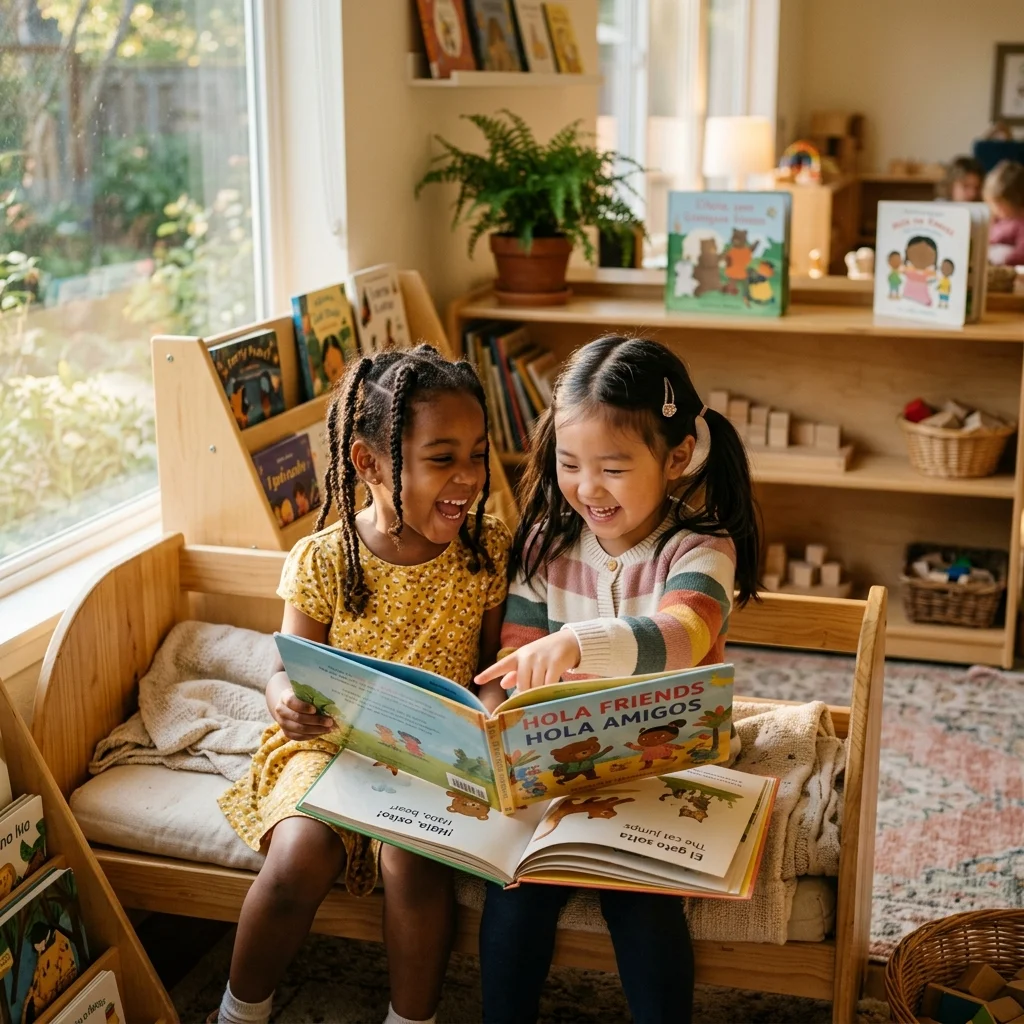
One of the quiet advantages of the Montessori mixed-age classroom in a bilingual context is peer-to-peer language modeling. In a traditional preschool, all children are at approximately the same language level. In a Montessori 3-to-6 classroom, a 5-year-old who has been immersed for three years naturally becomes a language model for the newly enrolled 3-year-old.
This creates a linguistically rich peer environment that no curriculum can replicate. Children are far more motivated to acquire language from an exciting older classmate than from a teacher. The older child also reinforces their own linguistic competence through this mentorship — a double learning benefit that is unique to the Montessori model.
6. How to Know If a Bilingual Program Is Real
Not all bilingual preschool programs deliver what they promise. When evaluating a school's language program, ask these specific questions:
- Is the second language used continuously, or only during a scheduled 30-minute period?
- Are teachers native or near-native speakers, or are they reading from a curriculum script?
- Is there a "one person, one language" immersion model, or is it translation-based?
- Are children encouraged to respond in the second language, or just to listen?
- Is the language integrated across all activities (practical life, math, outdoor) or limited to circle time?
At Montessori Academy, our bilingual teachers are conversationally fluent and use immersive, contextual instruction across all areas of the prepared environment. We encourage you to tour during the morning work cycle so you can observe the language integration firsthand. Schedule your campus tour here.
If cost is a concern, families may qualify for MAOF, CCTR, or CalWORKs childcare subsidies — particularly at our Downey campus. We work with families to explore every available subsidy option so that bilingual Montessori education remains accessible regardless of income level.
Frequently Asked Questions About Bilingual Preschool
At what age should a child start bilingual immersion?
The earlier, the better. Research confirms that the brain's most active sensitive period for language acquisition spans from birth to age 6. Enrolling as early as age 2 in a bilingual Montessori environment maximizes the window for effortless, accent-free fluency.
Will learning two languages at once confuse my child?
No. This is one of the most common myths in early childhood education. Decades of neurolinguistic research confirm that simultaneous bilingual learners are not confused — they simply build two parallel language systems. Temporary code-switching (mixing words) is normal and typically resolves by age 5.
Which languages does Montessori Academy offer at each campus?
Our Culver City and West Adams campuses offer both Mandarin and Spanish immersion. Our Downey campus offers Spanish, French, and Tagalog. All language instruction is woven into daily Montessori activities, not treated as a separate weekly class.
Is bilingual instruction included in tuition or an extra cost?
Bilingual immersion in Mandarin and Spanish is integrated into the core Montessori curriculum at no additional cost at our Culver City and West Adams campuses.
Does bilingual education improve cognitive abilities beyond language?
Yes. Multiple peer-reviewed studies show that bilingual children demonstrate stronger executive function, better attention control, improved working memory, and greater mental flexibility compared to monolingual peers — all skills that directly predict academic success.
How is Montessori bilingual immersion different from a weekly Spanish class?
A weekly class exposes a child to language for 30–60 minutes and is largely forgotten between sessions. In Montessori immersion, teachers speak Mandarin or Spanish continuously during practical life activities, circle time, and one-on-one work periods — creating hundreds of contextualized exposures per day.
How do I enroll my child in the bilingual program at Montessori Academy?
Bilingual immersion is part of every program at Montessori Academy — not a separate enrollment track. Simply schedule a tour at our Culver City campus at (310) 215-3388 or our West Adams campus at (323) 795-0200, complete the enrollment paperwork, and your child begins the immersive environment from their first day.
My child is already 5 — is it too late to start bilingual immersion?
Age 5 is still within the sensitive period for language acquisition (which extends to approximately age 6), so immersion at this age produces excellent results. While starting at 2 or 3 is ideal, a motivated 5-year-old in a full-immersion Montessori environment will make rapid, meaningful progress that would be very difficult to replicate in a traditional classroom setting.
Hear the Language in Action
Reading about bilingual immersion is one thing — hearing a 4-year-old confidently switch between English and Mandarin during a math lesson is another. Schedule a tour at our Culver City or West Adams campus and observe the bilingual environment during the morning work cycle. We welcome drop-in family days where your child can explore the classroom alongside current students.
Schedule Your Campus Tour