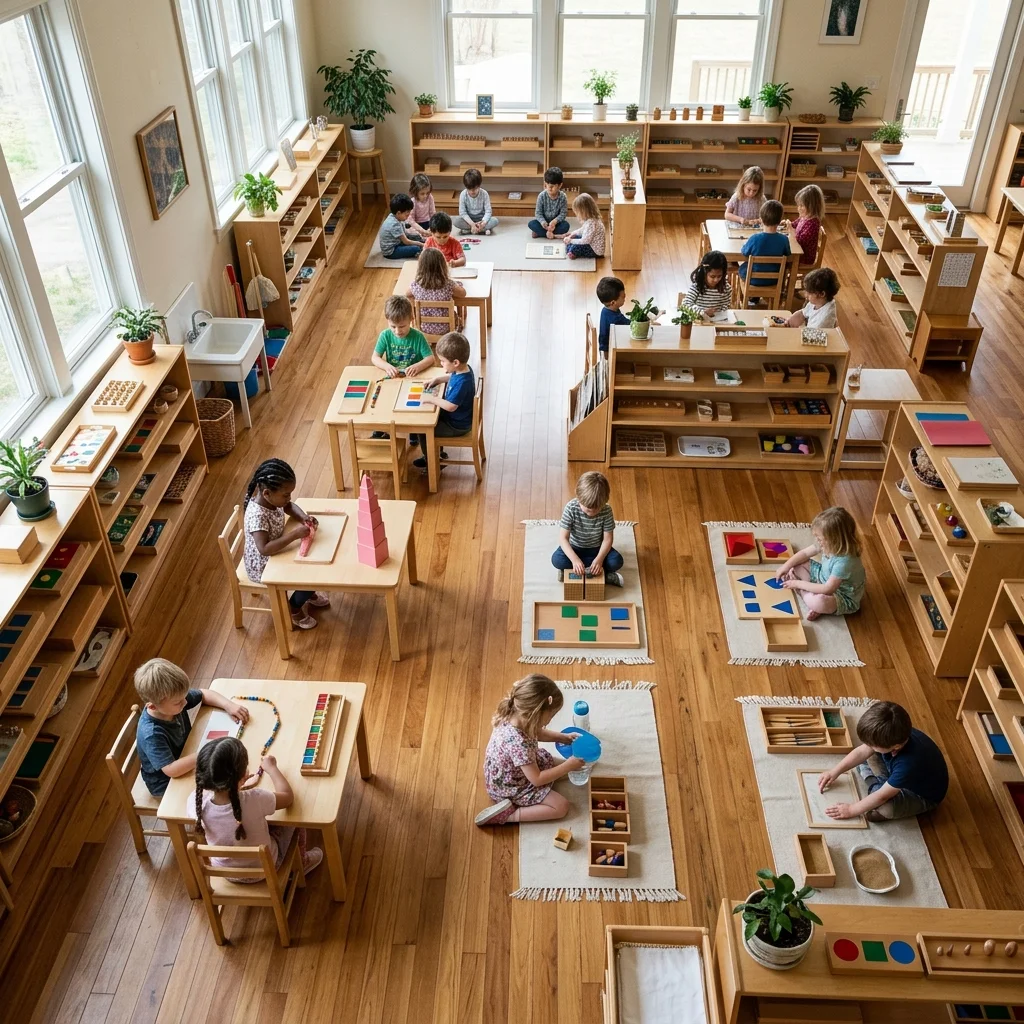
The Montessori Academy Daily Schedule
Montessori Academy operates from 7:00 AM to 6:00 PM, year-round at all three campuses. Below is the structure of a typical full day for a child in the Primary program (ages 3–6). The toddler program follows a similar structure adapted for younger children — see our Toddler Program page for details specific to ages 2–3.
The Montessori Work Cycle: Why Uninterrupted Time Matters
In a traditional preschool, a child's attention is interrupted every 20 to 30 minutes by a scheduled transition — circle time ends, art project begins, snack time, outdoor time, then another activity. Research in developmental psychology consistently shows that these transitions prevent children from reaching deep concentration.
Maria Montessori identified what she called the polarization of attention — a state where a child's entire being becomes absorbed in a task. She observed that when children reach this state, they emerge calmer, more purposeful, and more capable than before. The Montessori Work Cycle exists specifically to protect this state from interruption. A child who spends 45 minutes working intensely with the golden bead material is not "just playing" — they are building mathematical understanding, fine motor control, sequential reasoning, and intrinsic motivation simultaneously.
"The most important period of life is not the age of university studies but the period from birth to the age of six. For that is the time when man's intelligence itself is being formed."
— Maria Montessori, The Absorbent Mind
What Happens During the Work Cycle: The Child's Experience
A child arriving at 8:30 AM to the Montessori prepared environment walks into a room that is already set, orderly, and beautiful. The low wooden shelves are arranged by curriculum area — practical life to the left, sensorial materials in the center, language and mathematics to the right. Everything is within the child's reach. Everything has a designated place.
The child surveys the shelves and chooses their first work. Perhaps they have been working with the pink tower for several days and are ready to try the brown stair. They carry it to a mat on the floor, unroll the mat (a practical life act), build the stair from largest to smallest, pause, disassemble it, rebuild it a different way, then return everything — mat rolled, pieces aligned, material back on the shelf — before choosing their next work.
At some point during the morning, the guide sits beside the child and gives a brief three-period lesson introducing a new concept or material. This lesson is rarely more than 3–5 minutes long. Then the guide steps back and the child continues independently. In a Montessori mixed-age classroom (ages 3–6 in our Primary program), older children often become spontaneous teachers — explaining a material to a younger child with total confidence, which reinforces their own mastery.
This is why the sensitive period matters so much in Montessori practice. Each child is at a different stage in their developmental journey. The guide's job is to observe which sensitive period is active for each child — whether it is the sensitive period for language, for order, for small objects, or for movement — and offer the right material at the right moment. A 1:12 ratio makes this observation impossible. Our 1:5 ratio makes it the central practice of every morning.

What Montessori Children Do NOT Do During the Day
Understanding a Montessori day is as much about what is absent as what is present. A child at Montessori Academy will not:
- Sit at a desk all day waiting for teacher-led instruction
- Complete worksheets or coloring-book pages as a primary activity
- Be graded, tested, or compared to peers
- Be forced to move to a new activity before they are ready
- Wait passively for a group to finish so the next transition can begin
- Watch educational videos or use tablets as part of the curriculum
This absence of passive learning is not accidental — it is the pedagogical position that children learn by doing, not by watching. For the full research foundation behind this approach, see Why the Montessori Method Works.
The Toddler Day: How It Differs for Ages 2–3
Children in the Montessori toddler program follow a similar structure but with shorter concentration periods and more practical life emphasis. A 2-year-old's version of the work cycle involves sweeping, pouring, folding, and sorting — activities that build hand-eye coordination, concentration, and the confidence of completing real tasks. The Nido infant program at our Downey campus (for children 6 weeks to approximately 14 months) follows its own daily rhythm coordinated with each infant's individual feeding and sleep schedule.
At Montessori Academy Downey — directed by Veronica Tapia, CA Lic. #198400903, (562) 291-2324 — the Nido and toddler rooms maintain their own daily schedule with a 1:4 ratio, ensuring that infants and toddlers receive the individual attention their developmental stage requires.
Cost and Subsidies: Making This Day Accessible
Full-time tuition at Montessori Academy varies by campus — at our West Adams campus, rates are approximately $1,675–$1,850 per month for the full 7:00 AM–6:00 PM day described above, including all curriculum, language immersion, and extended care. Culver City rates are posted on the campus page. At our Downey campus, the majority of families enroll through MAOF, CCTR, CSPP, CalWORKs, or Head Start subsidies — which can make the entire day described in this article available at no out-of-pocket cost. Call Downey at (562) 291-2324 to discuss eligibility. For a full breakdown, see our Montessori Preschool Cost in Los Angeles guide.
Frequently Asked Questions — A Day in the Montessori Classroom
What is the Montessori Montessori Work Cycle?
The three-hour uninterrupted work cycle is the core of the Montessori morning. Children freely choose their own work from the prepared environment, complete it at their own pace, and return it before choosing again. No bells, no forced transitions, no teacher-directed activities. This uninterrupted block allows children to reach deep concentration — what Montessori called the "polarization of attention."
What time does the Montessori Academy school day start and end?
Montessori Academy opens at 7:00 AM and closes at 6:00 PM, year-round at all three campuses — Culver City (310-215-3388), West Adams (323-795-0200), and Downey (562-291-2324). The structured educational morning begins at 8:30 AM.
Do Montessori children have free play or recess?
Yes — outdoor time is part of every day. Children go outside after the morning work period for physical activity, gardening, and unstructured exploration. However, all time in the prepared environment is purposeful — even outdoor areas are designed with intention.
What do Montessori children do when they finish their work?
When a child finishes one piece of work, they return it to its place on the shelf — exactly as they found it — and choose another. The child is never asked to "wait" or sit idly. There is always another work available at the appropriate level.
How do Montessori teachers know what each child is working on?
Guides maintain detailed observation records for each child — noting which materials they have been introduced to, which they have mastered, and which sensitive period they appear to be in. Our 1:5 ratio (preschool) and 1:4 ratio (infant/toddler at Downey) make this individualized observation feasible.
Is there a nap time in the Montessori day?
Rest is available for younger children (ages 2–3) who need it. In the toddler program and Nido at Montessori Academy Downey, sleep schedules are respected individually. Older children in the Primary program (ages 3–6) have a quiet rest period available after lunch rather than a structured nap.
Can I observe my child's Montessori classroom during the day?
Yes. Montessori Academy welcomes parent observations — observers sit quietly without interacting with children or guides, preserving the concentration of the work period. Contact your campus to schedule: Culver City (310) 215-3388, West Adams (323) 795-0200, Downey (562) 291-2324.
Does the Montessori schedule work for working parents?
Yes. Our 7:00 AM–6:00 PM year-round schedule is designed for working families. Children in extended care continue to access materials in the prepared environment rather than watching screens or waiting passively.

See the Montessori Work Cycle in Person
Reading about a Montessori day is one thing. Watching 15 children move through the work cycle with quiet purpose — each choosing their own path, each absorbed in their own task — is something else entirely. We invite you to observe a morning at any of our three campuses. Most parents who tour leave saying the same thing: "I wish I had gone to school here."
Schedule Your Campus Tour