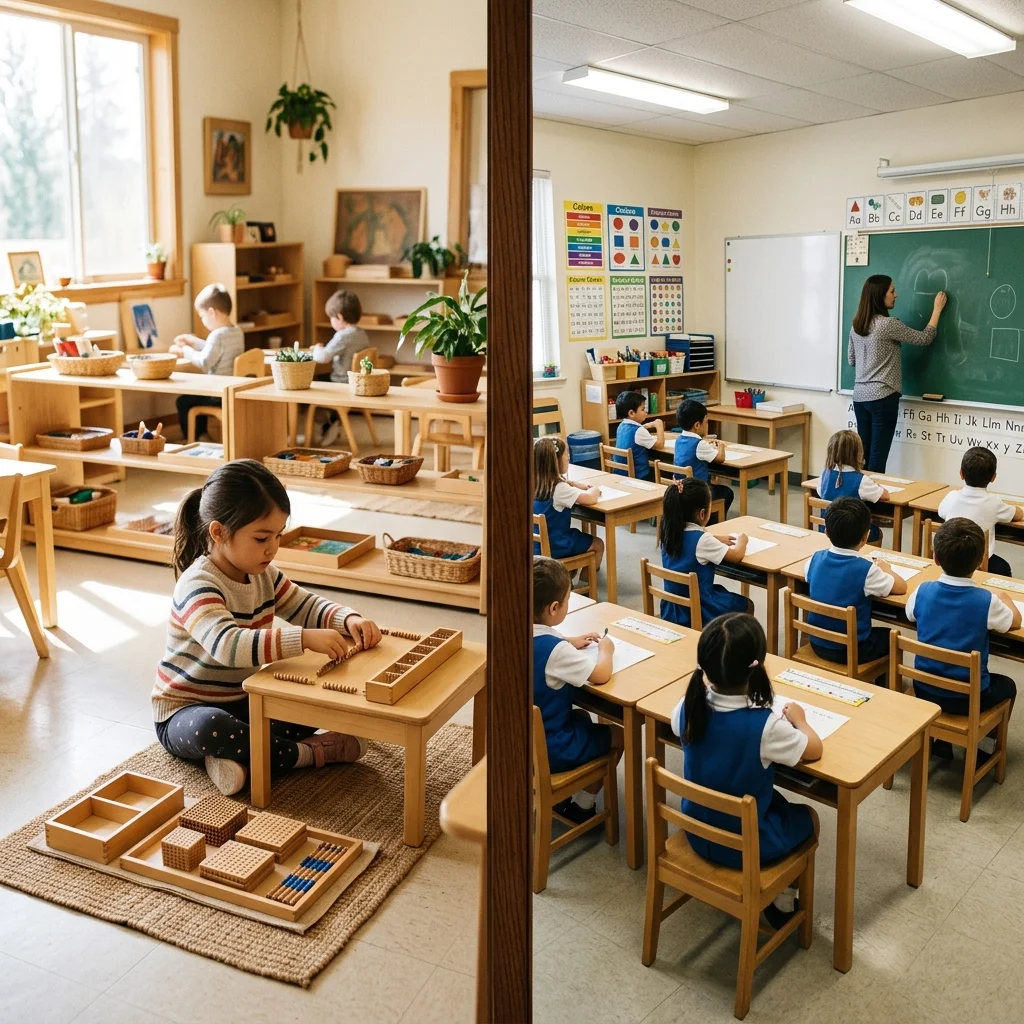
1. What Is California's TK Program, and Who Qualifies?
Transitional Kindergarten (TK) was created by California in 2012 as a bridge year for children who narrowly missed the kindergarten age cutoff. Under the original law, only children turning 5 between September 2 and February 2 were eligible. California's Universal TK (UTK) expansion, fully implemented in the 2025–26 school year, extended eligibility to all children who turn 4 by September 1 of the school year — regardless of birthdate.
TK is offered by your local public school district, operates during the regular school year (not summers), and follows a modified kindergarten curriculum aligned to California's Common Core standards. It is free, publicly funded, and teaches children in the standard classroom model: a teacher directing instruction in timed blocks for a group of up to 12 students.
Understanding this baseline is essential before comparing it to Montessori — because the two programs share almost nothing in common beyond serving 4-year-olds.
2. The Master Comparison: 10 Dimensions Side by Side
Rather than making vague claims, here is a direct, fact-based comparison across every dimension that matters to Los Angeles-area families:
| Dimension | Montessori Academy TK | Public TK (LAUSD / DUSD / CCUSD) |
|---|---|---|
| Cost | Tuition-based; MAOF/CCTR/CalWORKs subsidies accepted | Free |
| Teacher:Child ratio | 1:5 | Up to 1:12 (state minimum) |
| Hours | 7:00 AM – 6:00 PM, year-round | ~8:00 AM – 2:30 PM, school-year only |
| Curriculum approach | Child-directed; 3-hour uninterrupted work cycle | Teacher-directed; 20–30 min activity blocks |
| Classroom structure | Mixed-age (ages 3–6); child moves freely | Same-age cohort; assigned seating |
| Daily Language Classes | Mandarin + Spanish (CC/WA); Spanish/French/Tagalog (Downey) | Varies by site; rarely offered daily |
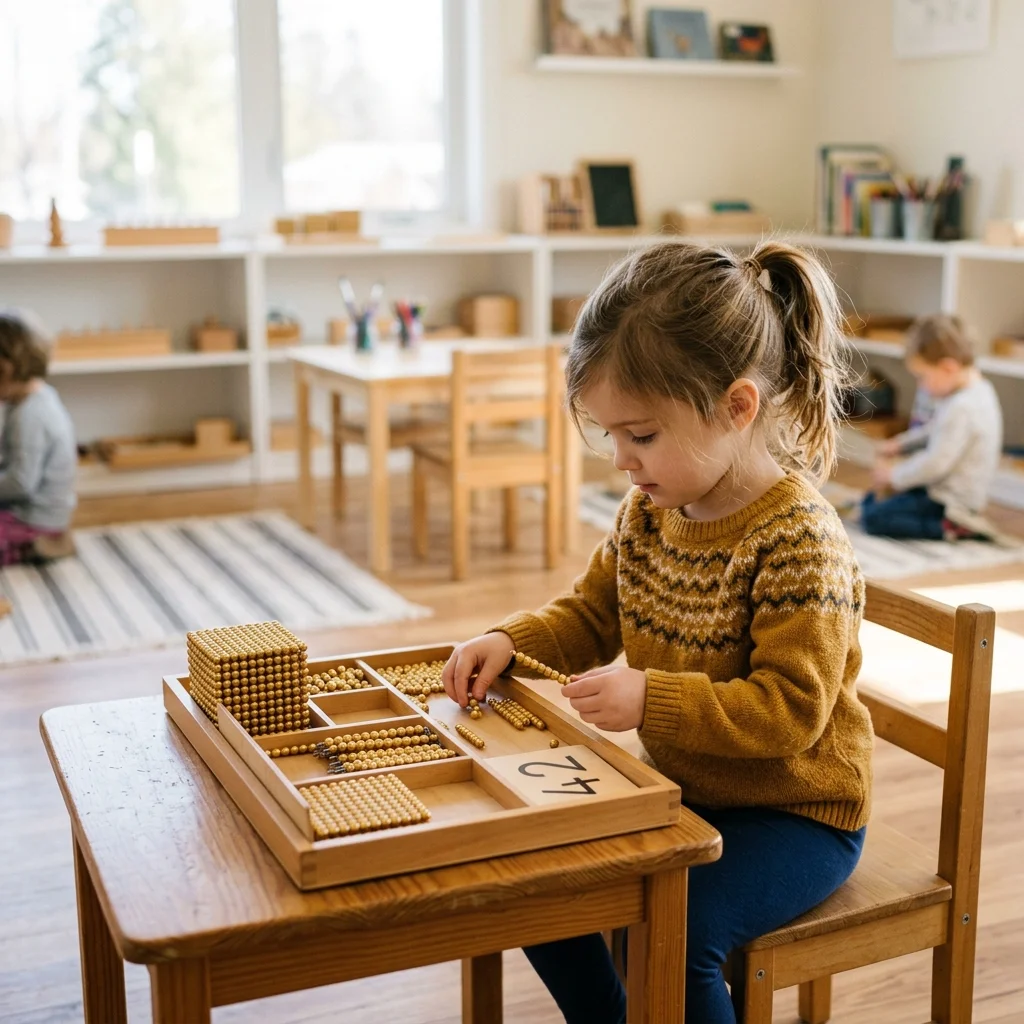
| Materials | Specialized wooden Montessori didactic materials | Standard classroom supplies |
| Summer care | Yes — year-round enrollment | No — separate summer program required |
| Path to elementary | Continues at Montessori Academy (Downey through 3rd grade) | Feeds into local public K–5 |
| Minimum age | Age 2 (or 6 weeks at Downey) | Must turn 4 by September 1 |
3. The Curriculum Gap: Montessori Work Cycle vs. 20-Minute Blocks
This is the most consequential difference that most families do not realize until they observe both environments. In a public TK classroom, the day is divided into structured activity blocks: 20 minutes of circle time, 20 minutes of reading, 20 minutes of math, and so on. The teacher directs each transition. Children rarely choose their own work or control their own pace.
In a Montessori prepared environment, the morning anchors on an uninterrupted Montessori Work Cycle. During this period, each child selects their own work from the shelf, carries it to a table or mat, completes it with full concentration, and returns it when finished. No bell interrupts their focus. No teacher dictates the sequence. The role of the Montessori guide is to observe, prepare the environment, and offer a new lesson at precisely the right moment in a child's development.
Decades of research — including the landmark 2006 Lillard & Else-Quest study in the journal Science — demonstrate that children in Montessori environments show superior executive function, reading, and math outcomes compared to children in traditional preschool settings. The Montessori Work Cycle is the structural reason why. To understand the science behind these results, read Why the Montessori Method Works.

4. Ratios: 1:5 vs 1:12 — What It Actually Means
California's TK ratio requirement is 1 adult for every 12 children. Montessori Academy maintains a 1:5 ratio across all three campuses — in Culver City (est. 1986), West Adams (est. 2019), and Downey (est. 2023). This is not just a number. At 1:12, a teacher physically cannot provide individualized instruction. At 1:5, your child is genuinely known, tracked, and responded to every single day.
In a mixed-age Montessori classroom of 15 children with 3 guides, an older 5-year-old naturally becomes a peer mentor for a newly enrolled 3-year-old. The social architecture of the environment does much of the teaching — a compounding advantage that a same-age, large-group TK class cannot replicate. Explore our full Transitional Kindergarten program to see this in detail.
5. Hours and Working Parents: The Year-Round Advantage
Public TK runs approximately 180 school days per year, from around 8:00 AM to 2:30 PM. That means:
- No care during summer — roughly 10 weeks per year
- No care on school holidays, teacher furlough days, or winter/spring breaks
- A gap of 3–4 hours after school if you work until 5:00 or 6:00 PM
- Need for a separate after-school program or nanny — an added cost that erodes the "free" advantage
Montessori Academy operates Monday through Friday, 7:00 AM to 6:00 PM, year-round, with closures only for major observed holidays. For two-income households, CalWORKs participants, or any family where both adults are employed, this is often the deciding factor.
The Bottom Line: When Each Option Is Right
Choose Public TK if: your family has flexible schedules, a stay-at-home parent, and cost is the primary constraint.
Choose Montessori Academy TK if: you need year-round full-day care, value a 1:5 ratio, want daily language classes in Mandarin and Spanish, or believe in child-directed learning during the sensitive period for development. If cost is the barrier — call us. MAOF, CCTR, CSPP, CalWORKs, and Head Start may cover far more than you expect.
6. The Cost Question: Is Montessori Actually Unaffordable?
For many families, the assumption is: public TK is free, Montessori is expensive, end of discussion. But this calculation ignores two critical factors.
First, California's subsidy ecosystem — MAOF, CCTR, CSPP, CalWORKs, and Head Start — exists precisely to help working and income-eligible families access quality private childcare. At Montessori Academy Downey, the majority of enrolled families use a childcare subsidy. The cost of our Culver City and West Adams programs ranges from approximately $1,675 to $1,850 per month for full-time enrollment, but this can be significantly offset or fully covered by subsidy programs for qualifying families.
Second, the actual cost of "free" TK includes: after-school care, summer camp or daycare, and potentially a separate infant/toddler program for younger siblings. When these are added up, the gap between public TK and Montessori narrows considerably for many families. Call our Culver City campus, our West Adams campus, or our Downey campus to discuss your specific situation.
Frequently Asked Questions — Montessori vs TK California
What is Transitional Kindergarten (TK) in California?
Transitional Kindergarten (TK) is a free, state-funded program for California children who turn 5 between September 2 and February 2. It serves as a bridge year before formal kindergarten, offered through public school districts. As of 2025–26, eligibility expanded to all 4-year-olds under Universal TK (UTK).
Is free public TK better than private Montessori?
Free TK has clear advantages in cost. However, Montessori offers significantly lower ratios (1:5 vs up to 1:12), a three-hour uninterrupted work cycle vs 20–30 minute teacher-directed blocks, year-round care, and daily language classes in Mandarin and Spanish. The "better" choice depends on your family's schedule, budget, and educational philosophy.
Does Montessori Academy offer a TK program?
Yes. Montessori Academy's Transitional Kindergarten program is offered at all three campuses — Culver City, West Adams, and Downey — and follows the Montessori method. Children in TK join our mixed-age Primary environment (ages 3–6) with the same 1:5 ratio, Montessori Work Cycle, and daily language classes in Mandarin and Spanish as younger students.
Who qualifies for California's free Universal TK program?
Under California's Universal TK expansion (fully implemented by 2025–26), all 4-year-olds are eligible for free TK regardless of birthdate. The program is offered by local school districts including LAUSD, DUSD (Downey), Culver City Unified, and others. Eligibility is based on age, not income.
Can I use MAOF or CCTR subsidies at Montessori Academy's TK program?
Yes. Families who qualify for MAOF, CCTR, CSPP, CalWORKs, or Head Start may be able to apply those funds toward Montessori Academy's TK program. Our admissions team will help verify your eligibility. This is especially applicable at our Downey campus where the majority of families are subsidy-funded.
What are the hours for public TK vs Montessori TK?
Public TK typically runs from approximately 8:00 AM to 2:00–3:00 PM on school days only — no summers, no school holidays. Montessori Academy runs from 7:00 AM to 6:00 PM, year-round, Monday through Friday. For working parents, this difference is often decisive.
Is Montessori TK accredited as a substitute for public kindergarten?
Montessori TK at Montessori Academy prepares children thoroughly for formal kindergarten. Many of our TK graduates transition directly into 1st grade or continue with our elementary program. California law allows parents to choose private schooling; our Montessori TK satisfies California's educational requirements for this age group.
What happens if my child misses the public TK cutoff date?
Under Universal TK, California now accepts all children who turn 4 by September 1 of the school year. If your child misses this cutoff or you prefer not to wait, Montessori Academy accepts children from age 2 (or 6 weeks at Downey), with no hard enrollment cutoff dates.
See the Montessori TK Difference in Person
The best way to understand why families across Culver City, West Adams, Leimert Park, Downey, and the surrounding communities choose Montessori Academy over free public TK is to observe a Montessori Work Cycle yourself. Schedule a morning tour and watch what self-directed learning actually looks like at age 4.
Schedule Your Campus Tour