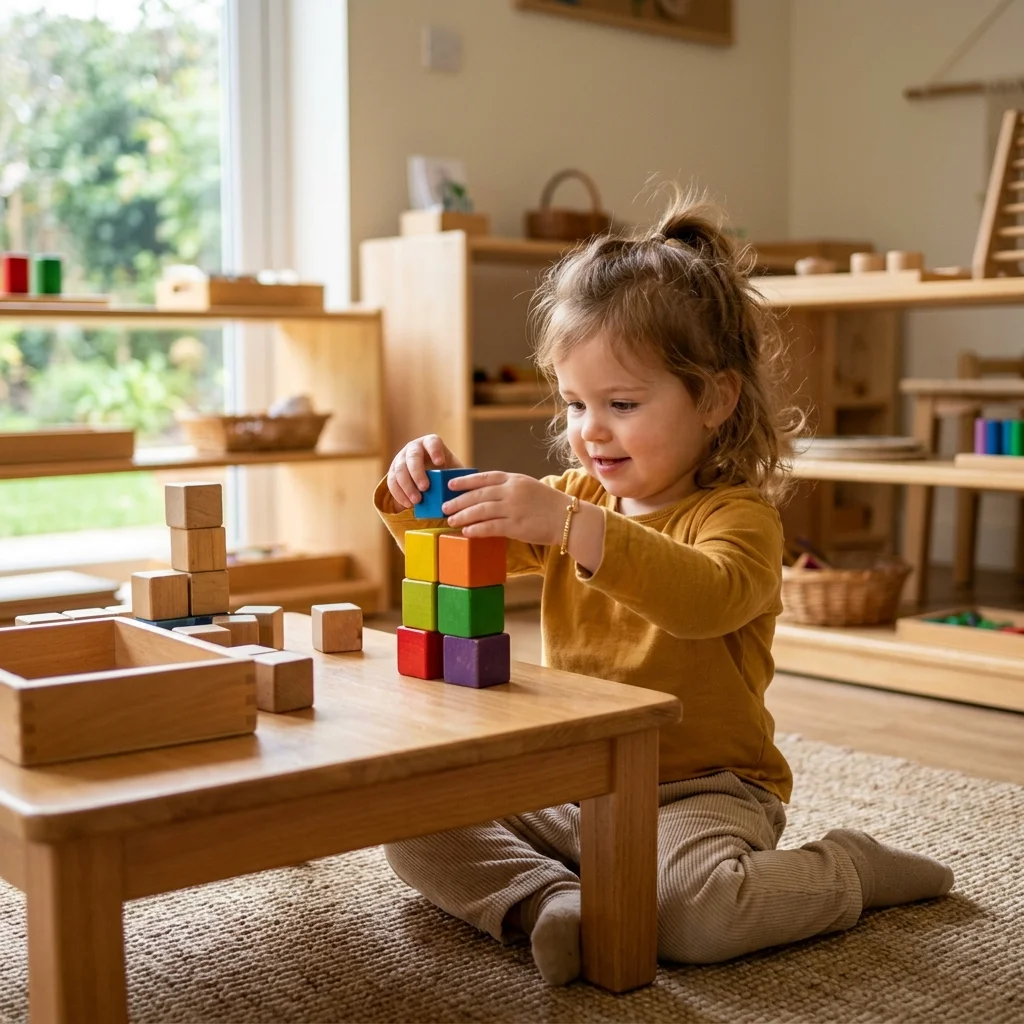
The 8 Signs of Toddler Preschool Readiness
Child development researchers and Montessori educators agree: preschool readiness is a cluster of behavioral and developmental indicators, not a single milestone. Children mature at different rates, and the Montessori environment is specifically designed to meet a child where they are, not where a curriculum says they should be. Look for these patterns over several weeks — not on a single day.
Curiosity About How Things Work
Does your child pull open every drawer, examine objects closely, or ask "why" and "what's that?" constantly? This is the sensitive period for exploration in full effect — a powerful signal of readiness for a prepared environment.
Desire for Independence ("I Do It!")
Toddlers who insist on doing things themselves — putting on shoes, pouring their water, carrying their plate — are demonstrating the drive for autonomy that the Montessori practical life curriculum is built around.
Sustained Attention Span
Can your child focus on a preferred activity for 3 to 5 minutes without needing adult redirection? This is the embryonic form of the concentration that will develop into the Montessori Montessori Work Cycle.
Interest in Other Children
Watching, approaching, or attempting to play alongside peers (parallel play is enough at age 2) signals social readiness. Montessori's mixed-age toddler classroom provides safe, intentional opportunities for peer interaction.
Ability to Follow Simple Directions
Two-step directions ("Pick up the ball and put it in the basket") are a strong indicator. This language comprehension is what allows a toddler to navigate a classroom environment independently.
Separation Tolerance
Your child does not need to leave you comfortably on day one — but if they can be successfully comforted by another trusted adult within a few minutes, they are likely ready to adapt to a new environment.
Emerging Language
Children do not need to be verbally advanced to start preschool. A toddler with 15–25 meaningful words and the ability to make their needs known (even through gesture) has the communication foundation to participate in classroom life.
Order-Seeking Behavior
The sensitive period for order peaks at ages 2–3. If your child becomes upset when routines are disrupted or insists that objects return to their "right" place, they are in the heart of a developmental window that Montessori environments are uniquely designed to serve.

What If Your Toddler Shows Only Some of These Signs?
This is the most important thing to understand about toddler readiness: you do not need a full checklist to enroll. A child who shows 4 or 5 of these 8 signals is very likely ready. The Montessori toddler program is specifically designed for children who are in the process of developing these capacities, not children who have already mastered them.
The prepared environment does much of the developmental work. A toddler who struggles with transitions at home often thrives in the consistent routine of the Montessori classroom. A child who cannot sustain 3 minutes of attention at home often achieves 10 or 15 minutes of deep concentration on a preferred material within their first few weeks. The environment is the teacher.
At our Downey campus, infants begin in the Nido (Italian for "nest") — a specialized prepared environment for children from 6 weeks of age — before progressing into the toddler program around their first birthday. The Nido maintains a 1:4 ratio to ensure every infant receives attentive, individualized care during this critical developmental window.
Our preschool programs across all campuses maintain a 1:5 teacher-to-child ratio for the Primary (ages 3–6) program. This is dramatically lower than California's minimum requirements and makes genuinely individualized instruction possible. Learn more about how our toddler Montessori program is structured to support children at every developmental stage — and how it connects to the broader framework explained in Why the Montessori Method Works.
Does My Child Need to Be Potty Trained?
No — and this surprises many families. Montessori Academy accepts children who are not yet potty trained at all three campuses. In the Montessori toddler program, practical life activities — including dressing, washing hands, and managing clothing — are a core part of the curriculum. This daily practice of self-care naturally accelerates the potty training process as an outgrowth of the child's growing independence.
Our teachers are experienced in supporting potty training in partnership with parents and will never shame a child for accidents. We treat toileting as a developmental milestone to be celebrated, not a gate to entry.
Separation Anxiety: A Sign of Attachment, Not Unreadiness
The most common fear parents have when considering preschool for a toddler is the morning separation. A child who cries at drop-off is not demonstrating that they are not ready — they are demonstrating that they have formed a healthy, secure attachment to their parent. These are exactly the children who, once settled, often become the most engaged learners in the classroom.
In the Montessori environment, the classroom itself is designed to capture a toddler's attention within minutes of arrival. The low, open shelves filled with beautiful materials, the sounds of other children working, and the calm presence of a familiar guide work together to create a welcoming transition. Our teachers are trained specifically in the separation transition and will always contact you if your child cannot be comforted within a reasonable period.

When Is the Best Time of Year to Start?
Unlike public schools, Montessori Academy operates year-round at all three campuses — Culver City (est. 1986), West Adams (est. 2019), and Downey (est. 2023). This means there is no "best" time of year to enroll. Children can join at any point throughout the year, and in the mixed-age Montessori toddler classroom, a new child is quickly absorbed into the social community of the group.
That said, many families find that starting during the summer months allows a gentler transition — the classroom is slightly smaller in July and August, giving new children more one-on-one time with their teacher during the adjustment period. Families in Culver City, Playa Vista, Mar Vista, Ladera Heights, Inglewood, West Adams, Leimert Park, Crenshaw, Downey, South Gate, Bellflower, Norwalk, and Paramount should contact their nearest campus to confirm current availability.
What About MAOF, CCTR, or Other Subsidies?
Cost should not be the reason a toddler misses this critical developmental window. Families who qualify for MAOF, CCTR, CSPP, CalWORKs, or Head Start may apply those funds toward our toddler program, particularly at our Downey campus where the majority of families are subsidy-funded. Our admissions team will help you determine eligibility and navigate the application process — call Downey directly at (562) 291-2324.
Frequently Asked Questions — Toddler Preschool Readiness
What age do most children start preschool?
Most children start preschool between ages 2.5 and 3. At Montessori Academy, our toddler program accepts children from age 2 (or 6 weeks at our Downey campus). The right age depends more on developmental readiness than the calendar — this article outlines the 8 signs to look for.
Does my toddler need to be potty trained to start preschool?
No. Montessori Academy accepts children who are not yet potty trained across all three campuses. Practical life activities in our toddler program naturally support the potty training process as part of the child's growing independence.
What if my toddler cries at drop-off?
Separation anxiety is completely normal and does not mean your child is not ready for preschool. In Montessori's prepared environment, the classroom quickly captures a toddler's interest. Most children settle within minutes of a parent leaving. Our toddler guides are trained to support this transition and will always call you if your child cannot be comforted.
What is the Montessori toddler program?
Montessori Academy's toddler program serves children ages 2–3 (starting from the Nido infant program at 6 weeks in Downey). The program uses a prepared environment with child-height shelves, practical life stations, language-rich activities, and a 1:4 toddler ratio (Downey) or 1:5 preschool ratio (all campuses). Children work at their own pace during a Montessori Work Cycle with no forced transitions.
How do I know if my 2-year-old is ready for Montessori specifically?
A 2-year-old is well-suited for Montessori if they show curiosity about how things work, can follow simple 2-step directions, can sustain attention on a preferred activity for 3–5 minutes, and are beginning to assert independence. The Montessori sensitive period for order peaks at ages 2–3, making this an ideal entry point.
Can I tour Montessori Academy's toddler program before enrolling?
Yes. We offer in-person tours, Zoom walkthroughs, and drop-in family days at all three campuses. Schedule a tour at our Culver City campus at (310) 215-3388, West Adams at (323) 795-0200, or Downey at (562) 291-2324.
What if my child has special needs or developmental delays?
The Montessori method is inherently individualized — each child works at their own pace with their own materials. Many children with sensory differences, speech delays, or developmental variations thrive in the low-stimulation, child-directed Montessori environment. We encourage families to discuss their child's specific needs with our admissions team before touring.
Does Montessori Academy accept MAOF or CCTR subsidies for the toddler program?
Yes. Families who qualify for MAOF, CCTR, CSPP, CalWORKs, or Head Start may apply those subsidies toward our toddler program — especially at our Downey campus. Contact the Downey admissions team at (562) 291-2324 to discuss eligibility.
Schedule a Toddler Program Tour
The best way to know if your toddler is ready is to let them explore the classroom themselves. We offer drop-in family days at all three campuses where your child can interact with materials and classmates while you speak with our teachers. Most families leave the tour with their answer.
Schedule Your Toddler Tour