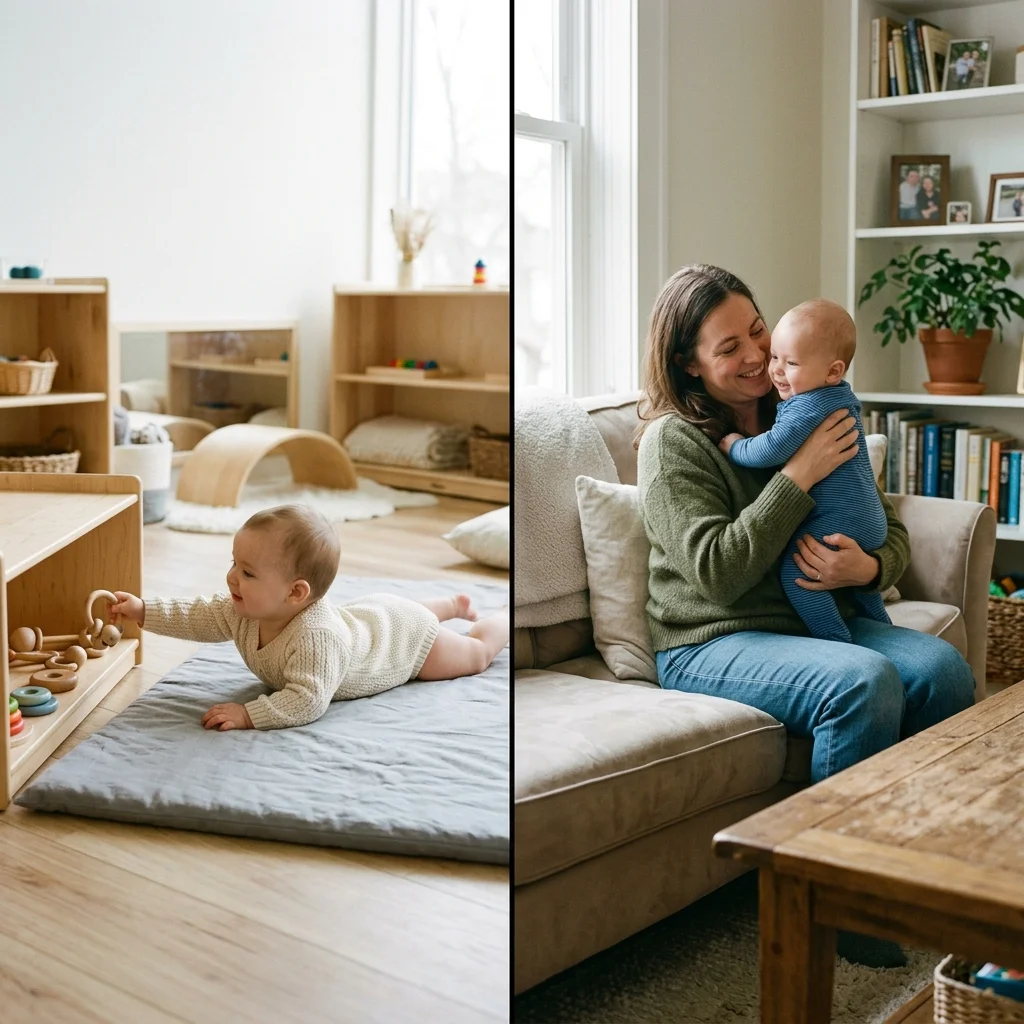
1. The Master Cost Comparison: 2026 Los Angeles
| Option | Monthly Cost | Annual Cost | Ratio | Key Trade-Off |
|---|---|---|---|---|
| Licensed infant daycare center | $1,400 – $2,800 | $16,800 – $33,600 | 1:4 (CA min) | Affordable; less individual attention |
| Montessori Nido (Downey) | Subsidy: $0 Private: varies |
Subsidy: $0 Private: varies |
1:4 | Developmental environment; subsidy eligible |
| Full-time nanny (live-out) | $3,200 – $5,000+ | $42,000 – $65,000+ | 1:1 | Maximum attention; highest cost |
| Nanny share (2 families) | $2,400 – $3,750 | $28,800 – $45,000 | 1:2 | Moderate cost; scheduling complexity |
| Au pair | $1,800 – $2,200 | $21,600 – $26,400 | 1:1 | Cultural exchange; requires spare room |
| Licensed family daycare (home) | $1,000 – $1,800 | $12,000 – $21,600 | 1:4 (CA) | Home environment; variable quality |
Hidden nanny costs: California requires nanny employers to pay payroll taxes (~10–12%), workers' comp insurance, paid sick leave (5+ days/year), and overtime for hours exceeding 9/day or 45/week. These add $5,000–$10,000/year on top of gross wages. Most families also provide 1–2 weeks paid vacation and a year-end bonus.
2. The Nanny Option: What $4,000/Month Actually Buys
A full-time live-out nanny in Los Angeles typically earns $20–$30/hour for 40 hours/week. At the midpoint ($25/hour), that's $4,333/month before taxes and benefits. The advantages are real: 1:1 attention, schedule flexibility, and care in your own home.
But there are trade-offs most families underestimate:
- No developmental curriculum. A nanny provides loving care, but very few nannies are trained in early childhood development. There is no prepared environment, no curriculum progression, and no developmental observation records.
- No peer socialization. An infant with a nanny is in a 1:1 environment all day. There are no other children to observe, imitate, or interact with.
- Backup care problem. When a nanny is sick, on vacation, or quits, you have no care. A center-based program has built-in staffing redundancy.
- Employer obligations. In California, you are a domestic employer. Payroll taxes, workers' comp, paid sick leave, and overtime are legally required — and many families ignore them at legal risk.
3. The Daycare Center Option: What $1,800/Month Buys
A licensed infant daycare center in Los Angeles typically charges $1,400–$2,800/month. At this price point, California law requires a minimum ratio of 1:4 (one caregiver per four infants). The advantages: professional staff, regulatory oversight, consistent hours, and built-in backup when a caregiver is absent.
The disadvantage: most licensed infant daycare centers are supervisory rather than developmental. Babies spend time in cribs, bouncers, and playpens. The caregivers manage safety and basic needs — feeding, diapering, soothing — but there is typically no structured developmental program, no sensory curriculum, and no intentional environment design.
4. The Montessori Nido: The Option Most Families Don't Know About
A Nido (Italian for "nest") is the Montessori infant environment for children from approximately 6 weeks to 14 months. It is neither a daycare nor a nanny — it is a purpose-built developmental environment based on 100+ years of Montessori research into infant development.
What makes a Nido different from a standard infant daycare room:
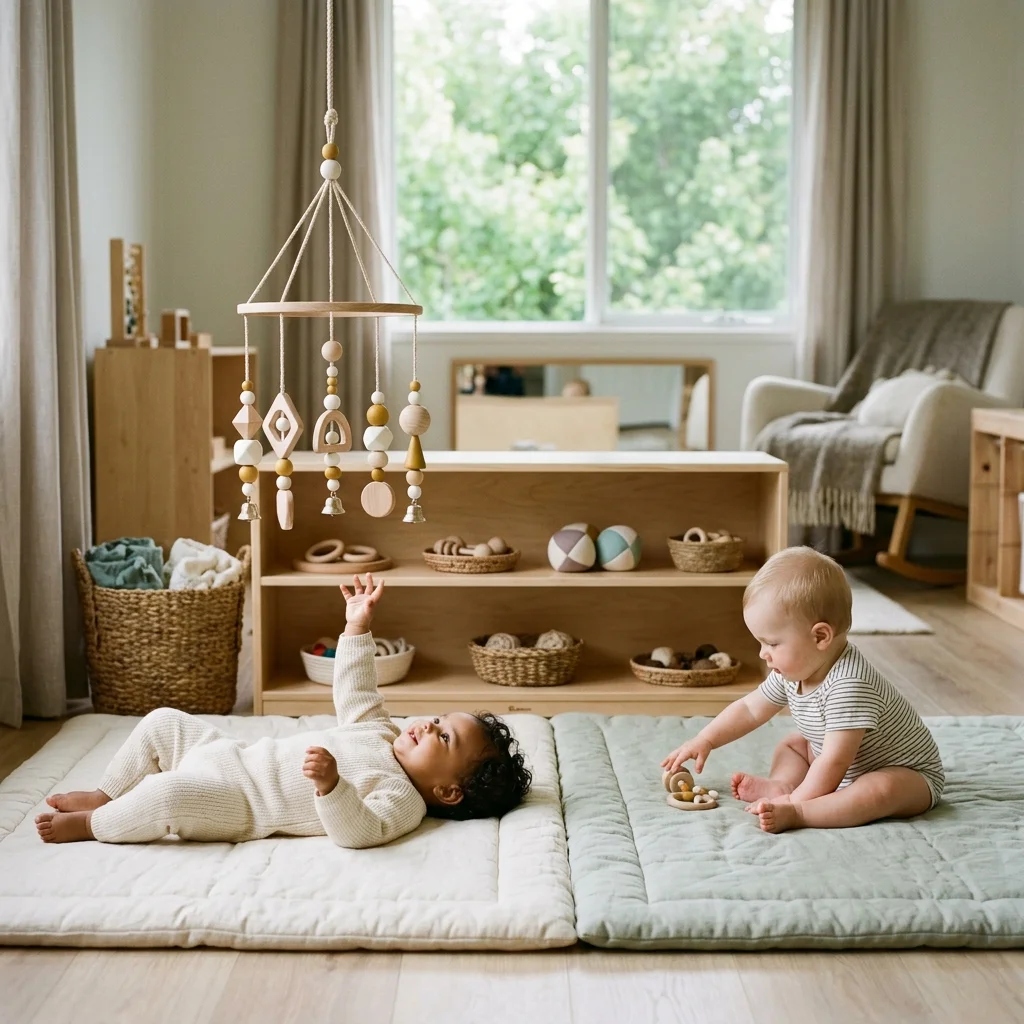
- Floor-based environment. Infants are placed on clean mats on the floor — not in cribs, bouncers, or containers. This supports the natural development of rolling, reaching, and crawling during the sensitive period for movement.
- Intentional materials. Carefully chosen mobiles, tactile objects, and grasping toys are positioned within reach. Each object is selected for its sensory properties — weight, texture, visual contrast — not because it is "cute."
- Prepared environment. The room is designed from the infant's perspective: low mirrors, natural light, calm colors, and uncluttered space. This is the same prepared environment principle applied to the entire Montessori continuum.
- Caregiving as curriculum. Every diaper change, feeding, and transition is treated as a cooperative interaction. The caregiver narrates, waits for the baby's response, and involves the infant in the process — laying the foundation for practical life independence.
Montessori Academy's Nido is offered exclusively at our Downey campus (7515 Firestone Blvd, Downey, CA 90241), directed by Veronica Tapia, CA Lic: #198400903, (562) 291-2324. The Nido maintains a 1:4 ratio — matching the California minimum but within a fundamentally different environment.
The subsidy advantage: Families in Downey, South Gate, Bellflower, Norwalk, Paramount, and surrounding communities who qualify for MAOF, CCTR, CSPP, CalWORKs, or Head Start can enroll their infant in the Montessori Academy Nido at no cost. A $0/month Montessori infant program vs. a $4,000/month nanny — for families who qualify, this is the single largest financial decision of their child's early years. Read our full MAOF Child Care Subsidy Guide for application steps.

5. The Nanny Share: A Middle Ground
A nanny share — where two families hire one nanny to care for both families' children — reduces per-family costs to roughly $2,400–$3,750/month. Your infant gets socialization with one other child, and the cost is 60–75% of a solo nanny.
The challenges: scheduling depends on two families' availability, illness in one child affects both families, the nanny is now managing two infants (a 1:2 ratio that is still better than a center's 1:4, but no longer 1:1), and finding a compatible share family is itself a significant effort. In Los Angeles, platforms like Nanno and Nanny Lane can help match share families, but the logistics are real.
6. The Au Pair Option
An au pair is a young person (typically 18–26) from another country who lives with your family for 1–2 years through a US State Department–approved agency. The cost is approximately $1,800–$2,200/month including agency fees, stipend, and the required education allowance. The trade-off: you must provide a private room and meals, the au pair has limited childcare experience (training is provided by the agency), and the arrangement is temporary by design.
For families in Culver City, West Adams, and surrounding Westside neighborhoods, an au pair can be a cost-effective option for infant care — especially combined with a Montessori toddler program transition at age 2.
7. Making the Decision: A Framework
There is no single "right" answer. The best infant care option depends on your family's specific situation:
- If you qualify for subsidies: Montessori Academy Downey Nido (MAOF/CCTR/CalWORKs) → $0/month for a Montessori developmental program. This is objectively the highest value option available.
- If you value 1:1 attention and can afford $4,000+/month: A full-time nanny provides the most individualized care, but lacks a developmental curriculum and peer socialization.
- If you want developmental quality at center-based pricing: The Montessori Nido at Downey provides the curriculum and environment of a nanny-level program at a center-based price point.
- If you need the lowest cost and don't qualify for subsidies: A licensed family daycare (home-based) at $1,000–$1,800/month is the most affordable option, though quality varies significantly.
For families on the Westside (Culver City, West Adams, Playa Vista, Mar Vista), our campuses accept children from age 2 in the toddler program — with West Adams tuition at approximately $1,675–$1,850/month. For a full tuition picture, see Montessori Preschool Cost in Los Angeles. To understand the full Montessori daily experience your child will have after infancy, read A Day in the Montessori Classroom.
Frequently Asked Questions — Infant Daycare vs Nanny Costs
How much does infant daycare cost in Los Angeles in 2026?
Licensed infant daycare centers range from $1,400 to $2,800/month. Southeast LA (Downey, South Gate, Bellflower) tends to be lower. MAOF subsidies can eliminate the cost entirely at approved providers like Montessori Academy Downey.
How much does a full-time nanny cost in Los Angeles?
$3,200–$5,000+/month ($20–$30/hour for 40 hours), plus payroll taxes (~10–12%), workers' comp, paid sick leave, and often paid vacation. Total annual: $42,000–$65,000+.
What is a nanny share and how much does it cost?
Two families hire one nanny. Each pays 60–75% of the full rate — roughly $2,400–$3,750/month per family in LA. Trade-off: scheduling complexity and reduced individual attention.
Does Montessori Academy offer infant care?
Yes. The Nido infant program at Montessori Academy Downey starts at 6 weeks, with a 1:4 ratio and a Montessori-prepared floor environment. Campus Director: Veronica Tapia, (562) 291-2324, CA Lic: #198400903.
Can I use MAOF or CCTR subsidies for infant care?
Yes. MAOF, CCTR, CSPP, CalWORKs, and Head Start subsidies all cover infant care at Montessori Academy Downey — often at $0 out of pocket. Call (562) 291-2324 to start the process.
Is a nanny or daycare better for an infant?
Neither is universally better. A nanny gives 1:1 attention at home. A Montessori Nido offers a purpose-built developmental environment with trained caregivers and peer interaction at a 1:4 ratio — a middle ground between nanny individualization and center-based structure.
What are the hidden costs of hiring a nanny in California?
Payroll taxes (~10–12%), workers' comp insurance, paid sick leave (5+ days/year), overtime, paid vacation, and year-end bonus. Adds $5,000–$10,000/year beyond gross wages.
What if I can't afford either a nanny or daycare?
If your income is below 85% SMI, you likely qualify for MAOF/CCTR/CalWORKs child care subsidies — covering full infant care at Montessori Academy Downey. Read our MAOF Child Care Subsidy Guide.

Tour the Montessori Academy Nido
See the infant environment that most families don't know exists. The Nido at Montessori Academy Downey is a purpose-built Montessori infant program — not a daycare room. If you qualify for MAOF or CCTR, it may cost you nothing. Tour during feeding or floor time to see the difference.
Call Downey: (562) 291-2324 Schedule a Tour