1. The Core Philosophy: Who Leads the Learning?
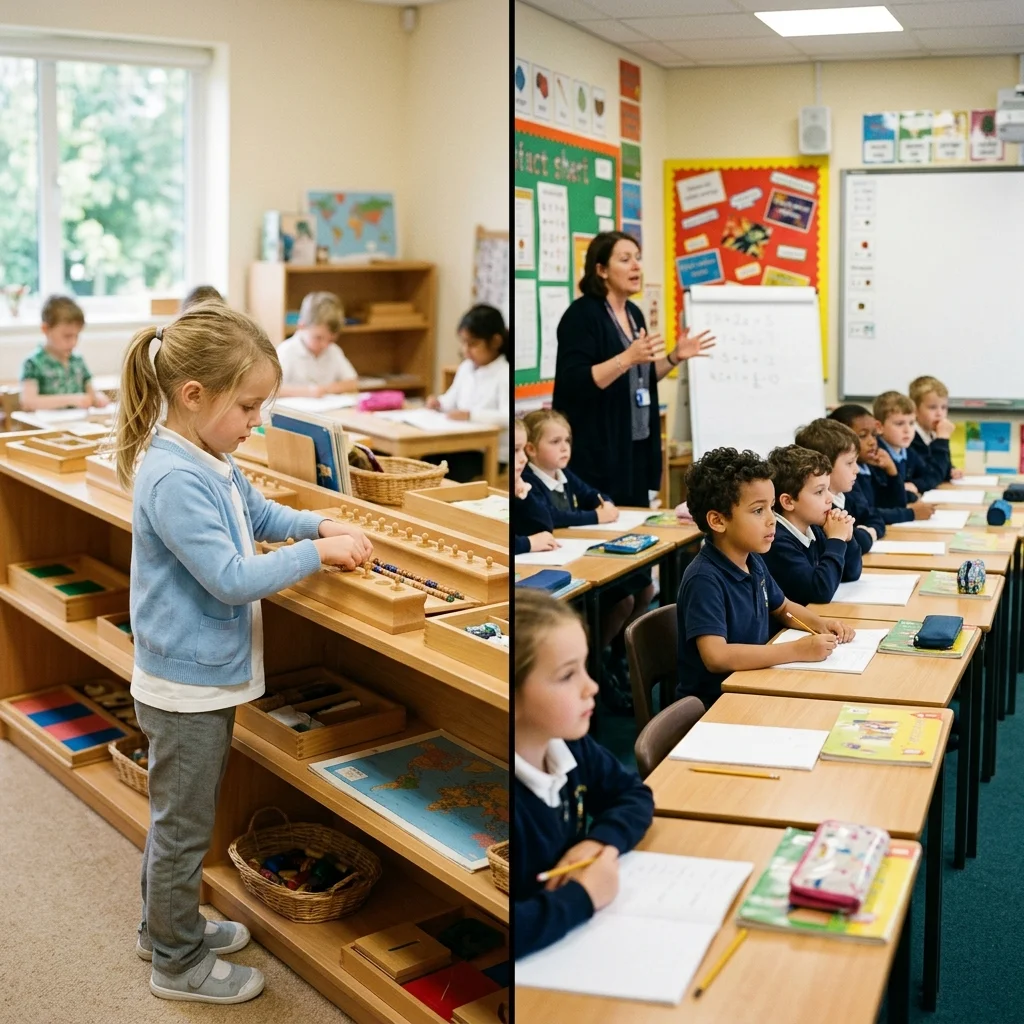
Every meaningful difference between Montessori and traditional preschool flows from a single philosophical split: who directs the child's activity.
In a traditional preschool, the teacher is the architect of the child's day. She plans the morning circle, chooses the art project, selects the story, and transitions the group from one activity to the next at timed intervals. Children participate in what is prepared for them. The implicit message is: learning is something that happens to you, delivered by an adult who knows what you need.
In a Montessori classroom, the teacher — called a "guide" — prepares the environment and then steps back. The child selects their own work from the shelves, carries it to a mat or table, completes it, and returns it. The three-hour uninterrupted work cycle exists to protect the child's concentration from premature interruption. The implicit message is: learning is something you do, driven by your own curiosity and readiness.
This is not a small stylistic difference. It produces fundamentally different outcomes in executive function, intrinsic motivation, and self-regulation — and decades of research confirm it. Read the full evidence base in our article on Why the Montessori Method Works.
2. The Master Comparison: 9 Dimensions Side by Side
| Dimension | Montessori Preschool | Traditional Preschool |
|---|---|---|
| Who leads learning | Child-directed; teacher observes | Teacher-directed; class follows |
| Classroom structure | Mixed-age (3–6); freedom of movement | Same-age cohort; assigned seating |
| Daily schedule | 3-hour uninterrupted work cycle | 20–30 min rotating activity blocks |
| Materials | Specialized didactic materials (self-correcting) | Standard art supplies, worksheets, toys |
| Teacher's role | Observer, environment-preparer, lesson-giver | Instructor, activity-leader, group-manager |
| Assessment | Ongoing observation; no tests or grades | Structured evaluations, report cards |
| Practical life curriculum | Core — pouring, folding, cleaning, dressing | Incidental — not a structured curriculum area |
| Language immersion | Daily (Mandarin, Spanish, French, Tagalog) | Rare; typically an optional add-on |
| Teacher:child ratio | 1:5 at Montessori Academy | Varies; often 1:8 to 1:12 |
3. The Classroom Environment: Prepared vs. Standard
Walk into a traditional preschool classroom and you will typically see a teacher's desk at the front, tables arranged in clusters or rows, and shelves of shared materials managed by the teacher. The room is designed for group instruction.
Walk into a Montessori prepared environment and you see something different: low, open shelves arranged around the perimeter, each holding carefully sequenced materials in isolated presentation. Every object has a place and a purpose. The child-height furniture, the orderly arrangement, the absence of visual clutter — all of this is intentional. The room itself teaches. A child who has been shown how the environment works can navigate it independently, making choices without adult intervention.
4. The Teacher's Role: Guide vs. Director
In a traditional preschool, a skilled teacher is evaluated on her ability to engage the whole group, manage transitions, and deliver a planned curriculum. Her energy goes outward — toward the group.
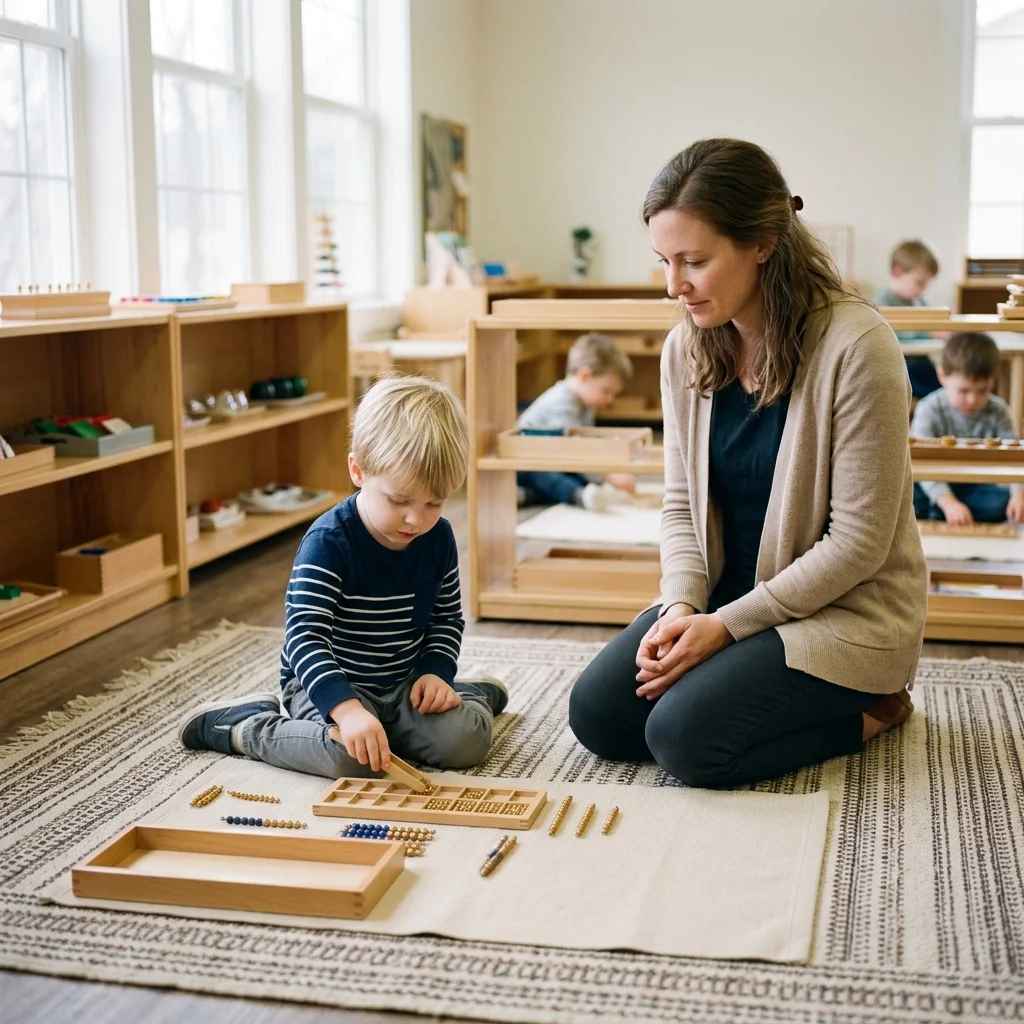
A Montessori guide is evaluated on her ability to disappear from the child's awareness. The highest compliment is a classroom where children are so deeply absorbed in their work that they barely notice the adult. The guide spends the morning observing each child — tracking which materials they have mastered, which sensitive period they appear to be in, and when the moment is right to introduce a new lesson. This observation-based assessment replaces tests and report cards entirely.
Our guides at all three Montessori Academy campuses hold AMS, AMI, or NAMTA credentials with an average of 5 to 30 years of experience. They are among the most highly trained preschool teachers in the Los Angeles area.
5. The Montessori Work Cycle: Why Interruption Is the Enemy
The most misunderstood feature of Montessori education is the Montessori Work Cycle. Parents sometimes ask: "What do children do for three hours?" The answer is: they work. But the deeper point is what the uninterrupted period does to a child's developing brain.
When a child enters deep concentration on a material — what Montessori called the "polarization of attention" — they are doing some of the most important developmental work of their lives. They are building the capacity for sustained focus, for trying and failing and trying again, for the intrinsic satisfaction of completing something difficult. This state cannot be achieved in a 20-minute activity block. It requires time, silence, and freedom from external interruption.
"At age 5, Montessori children performed significantly better on executive function tasks, reading, math, vocabulary, and social problem-solving than children in conventional preschools."
— Lillard & Else-Quest, Science, 2006
6. Practical Life: Curriculum, Not Enrichment
In a traditional preschool, practical skills — putting on a coat, washing hands, pouring juice — are managed by teachers and treated as transitions between "real" activities. In Montessori, practical life is the foundation of the entire curriculum.
A child who learns to pour water from a pitcher to a glass is not doing a cute activity. They are developing fine motor control, concentration, hand-eye coordination, and the satisfaction of completing a real task with real consequences. When they pour and it spills, they learn to clean it up — without shame, without adult intervention. This is how independence and responsibility are built: not by teaching them as abstract values, but by giving children work that actually matters.
7. Mixed-Age Classrooms: The Hidden Advantage
One of the most powerful but least discussed features of Montessori is the mixed-age classroom (ages 3–6 in the Primary program). In a same-age traditional preschool classroom, all children are at roughly the same developmental level. There is no one to aspire toward, and no one who needs your leadership.
In a Montessori mixed-age classroom, a newly enrolled 3-year-old watches a 5-year-old complete a complex task. They aspire to that level of mastery. Two years later, that same child becomes the 5-year-old — reinforcing their own learning by modeling for younger peers. Research consistently shows that teaching accelerates mastery more than any other form of practice. Montessori classrooms are structured to create this dynamic naturally every single day.
8. Cost, Subsidies, and the Affordability Question
Traditional preschools in Los Angeles typically range from $800 to $2,200 per month. Montessori Academy's programs are positioned in this range, with West Adams tuition at approximately $1,675–$1,850 per month for full-time enrollment. Culver City rates are posted directly on the website.
At our Downey campus, the majority of families are enrolled through MAOF, CCTR, CSPP, CalWORKs, or Head Start subsidies — making Montessori education completely accessible regardless of income level. If you are comparing Montessori Academy to a subsidized traditional daycare, call our Downey admissions team at (562) 291-2324 to understand your subsidy options before making a cost-based decision.
For a deeper look at pricing across all three campuses, visit our Culver City or West Adams campus pages, or see Montessori Preschool Cost in Los Angeles. If you are weighing free public TK against Montessori, read our detailed Montessori vs TK in California comparison.
Frequently Asked Questions — Montessori vs Traditional Preschool
What is the main difference between Montessori and traditional preschool?
The core difference is who directs the learning. In a traditional preschool, the teacher plans and leads activities for the whole class in timed blocks. In a Montessori classroom, the child selects their own work and works at their own pace during an uninterrupted Montessori Work Cycle. The teacher observes and guides rather than directs.
Is Montessori preschool better than traditional preschool?
Research published in Science (Lillard & Else-Quest, 2006) shows Montessori children demonstrate stronger executive function, reading, math, and social skills than peers in traditional preschools. However, "better" depends on your child's temperament and your family's values. Montessori is most effective for children who are intrinsically curious and benefit from a calm, orderly environment.
Do Montessori children do better academically?
Multiple longitudinal studies show Montessori children perform at or above traditional school peers in reading and math, with particular advantages in executive function — self-regulation, planning, and working memory — the strongest predictors of long-term academic success.
What age is best to start Montessori preschool?
The ideal entry point is during the sensitive period for order (ages 2–3). At Montessori Academy, we accept children from age 2 at Culver City and West Adams, and from 6 weeks (Nido infant program) at our Downey campus.
How do I enroll my child in Montessori Academy's preschool program?
Contact your nearest campus: Culver City at (310) 215-3388, West Adams at (323) 795-0200, or Downey at (562) 291-2324. We offer in-person tours, Zoom walkthroughs, and drop-in family days. Your child can typically start within 2–3 weeks of completing paperwork.
Can my child transition from Montessori to a traditional school later?
Yes — and they typically thrive. Montessori graduates are known for their ability to work independently, manage their time, and pursue learning without constant external motivation. These traits are assets in any educational environment.
Does Montessori Academy accept MAOF or other childcare subsidies?
Yes. Families qualifying for MAOF, CCTR, CSPP, CalWORKs, or Head Start may apply those subsidies toward enrollment — particularly at our Downey campus. Call (562) 291-2324 to discuss eligibility.
What happens if Montessori is not the right fit for my child?
We will always be honest with you. Most children who struggle initially simply need more transition time. We have never had a child who could not eventually settle into the Montessori environment given sufficient time and family partnership.
See Montessori in Action
No article can fully convey the difference between Montessori and traditional preschool. The Montessori Work Cycle, the child-selected materials, the quiet concentration of a mixed-age classroom — these things must be observed to be understood. We invite you to tour any of our three campuses and see it for yourself.
Schedule Your Campus Tour