1. What Is a Licensed Daycare vs a Preschool in California?
In California, "daycare" formally refers to a licensed childcare center — a facility regulated by the California Department of Social Services (CDSS) to provide supervision and care for children. The licensing requirements focus on safety, ratios, and physical environment. They say relatively little about educational programming.
A preschool is a more specific category: an educational program for children ages 3–5 that follows a defined curriculum. In practice, the lines blur — many facilities call themselves "preschool" while operating primarily as supervised childcare, and vice versa. Montessori Academy holds both a California Community Care license and operates a structured Montessori educational program at all three campuses. We are a preschool that also functions as full-day childcare — not one or the other.
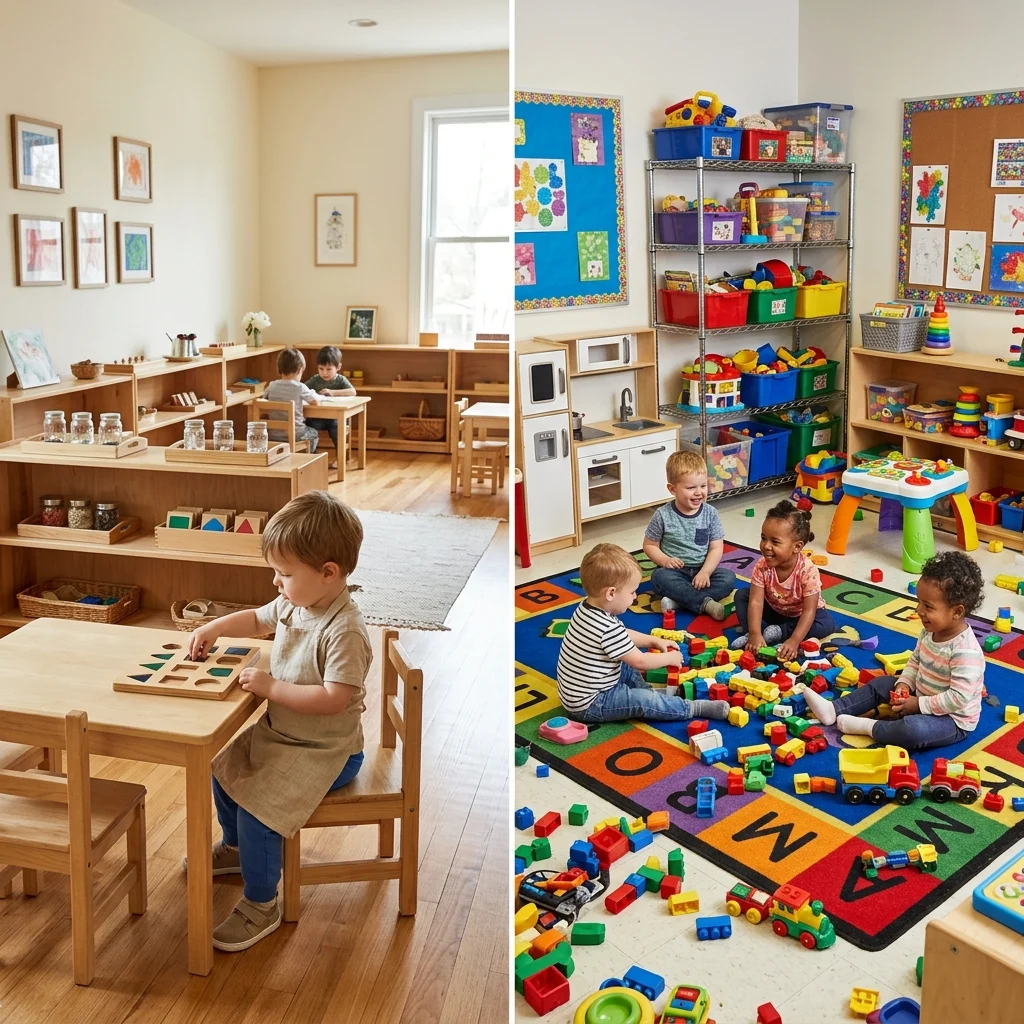
The key question is not "daycare or preschool" — it is "what does my child actually do for 8 hours?" Supervision is not education. The physical safety of a licensed daycare is necessary but not sufficient for the developmental outcomes most parents want.
2. The Comparison: 8 Dimensions Side by Side
| Dimension | Montessori Academy | Typical Licensed Daycare (CA) |
|---|---|---|
| Primary purpose | Education + full-day care | Supervision + full-day care |
| Educational philosophy | Montessori — child-directed, prepared environment | Varies or absent; often play-based supervision |
| Infant ratio | 1:4 (Downey Nido) | 1:4 (CA minimum) |
| Preschool ratio | 1:5 at Montessori Academy | Up to 1:12 (CA minimum) |
| Hours | 7:00 AM – 6:00 PM, year-round | Varies; often 7:00 AM – 6:00 PM |
| Language program | Daily bilingual immersion (Mandarin, Spanish, French, Tagalog) | Rarely offered |
| Infant environment | Montessori Nido — floor beds, mobiles, sensory station | Standard crib room or play pen area |
| MAOF/CCTR/CalWORKs | Accepted — especially Downey campus | Many licensed daycares also accept |
3. The Infant Question: Nido vs Standard Infant Daycare
For families with children under 18 months, the choice between Montessori and daycare is most acute — and most consequential. In a standard licensed infant daycare room, babies typically spend time in cribs, bouncers, and group play pens. Caregivers manage a group of infants with a 1:4 ratio and focus primarily on feeding, diapering, and safety.
In the Montessori Nido (Italian for "nest"), the infant environment is intentionally prepared for movement, sensory development, and independent exploration. Infants are placed on floor mats, not in cribs. Carefully chosen mobiles and tactile objects are within reach. The floor space is clean, safe, and designed to support the baby's natural drive to reach, roll, and eventually crawl toward objects of interest. This is not decorative — it is the foundational application of the Montessori prepared environment principle to the first year of life.
Montessori Academy's Nido infant program is offered exclusively at our Downey campus (7515 Firestone Blvd, Downey, CA 90241), serving families from Downey, South Gate, Bellflower, Norwalk, Paramount, Bell Gardens, Compton, Cerritos, Artesia, Lakewood, Long Beach, and surrounding communities from 6 weeks of age. Campus Director: Veronica Tapia · (562) 291-2324 · CA Lic: #198400903.

4. The Preschool Ratio Gap: 1:5 vs 1:12
California's ratio minimum for preschool-age children in a licensed childcare center is 1:12 — one adult for every twelve 3-to-5-year-olds. This is the legal floor, and many daycares operate at or near this number to manage costs. At 1:12, a caregiver cannot provide individualized instruction. She is managing a group.
Montessori Academy maintains a 1:5 ratio across all three campuses for preschool-age children. In a classroom of 15 children, there are 3 guides — each of whom knows every child's developmental stage, current interests, and active material sequence. This is not incidental. It is the structural requirement of the Montessori method, which depends on the guide's ability to observe and respond to individual children throughout the day.
Because our classrooms are mixed-age (ages 3–6 in the Primary program), a 3-year-old shares the room with 4- and 5-year-olds. Older children naturally model more advanced work, and younger children aspire toward it — a peer-learning dynamic that cannot exist in a same-age daycare group. During the Montessori Work Cycle, each child also engages in practical life activities: pouring, folding, sorting, and caring for the environment. These are not fillers — they are the curriculum foundation that builds fine motor control, concentration, and independence.
Children in the sensitive period for order (ages 2–3) are especially well-served by the Montessori structure, which provides consistent routines and a perfectly arranged prepared environment. For the full evidence base on why this matters, read Why the Montessori Method Works.
5. Subsidies: Can I Use My MAOF Daycare Funds at Montessori Academy?
Yes — and this is one of the most important things Los Angeles families do not know. If you currently receive MAOF, CCTR, CSPP, CalWORKs, or Head Start funds for a licensed daycare, you may be able to transfer those funds to Montessori Academy simply by updating your approved provider with the subsidy agency. The subsidy process is the same; only the school changes.
This is particularly relevant at our Downey campus, where the majority of families are subsidy-funded. For families at our West Adams campus or Culver City campus who are not subsidy-eligible, full-time tuition at West Adams is approximately $1,675–$1,850 per month — comparable to many quality licensed daycares in the area. Families in communities that have historically relied on daycare subsidies — including those in Lynwood, Huntington Park, Maywood, Vernon, Whittier, Carson, and Hawaiian Gardens — are often eligible to apply the same funds toward Montessori Academy enrollment. Call our Downey team at (562) 291-2324 to discuss the transition process.

6. When Daycare Might Actually Be the Right Choice
Intellectual honesty matters. There are situations where a licensed daycare is genuinely the better option for a family:
- Location: If no Montessori Academy campus is within a reasonable commute of your home or work, proximity may outweigh educational philosophy.
- Sibling scheduling: If you have multiple children at different facilities with conflicting schedules, consolidation at a single licensed daycare may be a practical necessity.
- Cost after subsidies: If your subsidy does not cover a private Montessori program in your area and the gap is beyond your budget, a licensed childcare center is a responsible choice.
- Overnight or drop-in care: Montessori Academy does not offer overnight or emergency drop-in care. Some licensed daycares do.
If none of these apply to your situation, we believe Montessori Academy offers a meaningfully better environment for your child's development. We also offer part-time enrollment — any 3 days per week or a half-day schedule — as an alternative to full-time daycare. For a broader comparison of program options, see Montessori vs Traditional Preschool or Montessori vs TK in California.
Frequently Asked Questions — Montessori vs Daycare
What is the difference between Montessori and daycare?
Daycare (licensed childcare center) is primarily a supervisory service — keeping children safe, fed, and engaged while parents work. Montessori is an educational philosophy built on child-directed learning, a prepared environment, and a three-hour uninterrupted work cycle. Montessori Academy is both a licensed childcare provider and a Montessori school — offering full-day, year-round care with a genuine educational program.
Is Montessori better than daycare for infants?
For infants, the most important factors are ratio, caregiver consistency, and environment design. Montessori Academy's Nido infant program at Downey maintains a 1:4 ratio with a purposefully prepared floor environment that supports motor and sensory development — significantly beyond what most licensed daycares provide.
Can Montessori Academy function as full-day childcare?
Yes. Montessori Academy operates from 7:00 AM to 6:00 PM, year-round at all three campuses — Culver City (310-215-3388), West Adams (323-795-0200), and Downey (562-291-2324).
Does Montessori Academy accept MAOF, CCTR, or CalWORKs in place of daycare subsidies?
Yes. Families who use MAOF, CCTR, CSPP, CalWORKs, or Head Start for daycare can often transfer those funds to Montessori Academy — particularly at our Downey campus. The subsidy process is the same; only the school changes. Call (562) 291-2324 to verify your eligibility.
What is the teacher-to-child ratio at Montessori Academy vs a daycare?
California licensed daycares are required to maintain up to 1:12 for preschool-age children. Montessori Academy maintains a 1:4 ratio for infants/toddlers (Downey Nido) and a 1:5 ratio for preschool-age children — dramatically better than the California minimum for older children.
How do I switch my child from their current daycare to Montessori Academy?
Contact your nearest Montessori Academy campus to schedule a tour. Once you enroll, we handle the transition timeline with you — most families complete paperwork within one week and can start within 2–3 weeks. If you use a subsidy (MAOF, CCTR, etc.), we will help you update your provider information with the subsidy agency.
What if my child is attached to their daycare and resistant to change?
We offer drop-in family days where your child can experience the Montessori classroom before formally enrolling. Most children who visit our classroom during a family day are eager to return. The richness of the prepared environment and the presence of engaged peers is itself a powerful draw.
What if I only need part-time care?
Montessori Academy offers part-time enrollment at all three campuses — any 3 days per week or a half-day schedule. This is ideal for families who need fewer hours than a traditional full-day daycare provides.
Tour Montessori Academy — Full-Day Care With a Real Curriculum
See for yourself what separates Montessori Academy from a licensed daycare. Our morning tours let you observe the Montessori Work Cycle in action, meet the guides, and compare our prepared environment with what your child currently experiences. All three campuses offer morning tours, Zoom walkthroughs, and drop-in family days.
Schedule Your Campus Tour