All 3 Campuses · No Requirement

Montessori Academy Not potty trained yet?
That's perfectly fine.

Many preschools turn families away if their child isn't toilet-independent. We don't. Montessori Academy accepts children who are still working on potty training at all three LA campuses — Culver City, West Adams, and Downey.


No potty training requirement Culver City · West Adams · Downey Shame-free, Montessori approach

Yes — Montessori Academy accepts children who are not yet potty trained. All three campuses. No exceptions, no waitlist for "trained only" spots.

The Montessori Approach

How the prepared environment supports toilet independence.

Montessori doesn't treat potty training as a prerequisite. It treats it as a developmental milestone — one that the prepared environment is specifically designed to support naturally, without pressure.

01

Child-Sized Everything

Montessori classrooms have child-sized toilets, low sinks, and accessible bathroom spaces that children can use independently. This is not an accommodation for children in training — it is a standard feature of every Montessori prepared environment. Children can initiate toilet visits without waiting for adult assistance.

02

No Shame. No Pressure.

When a child has an accident, Montessori Academy teachers respond calmly, matter-of-factly, and without shame or punishment. Research in child development is clear: shame-based approaches to toilet training slow progress and create anxiety. Our teachers are trained to normalize the process and keep the child's dignity intact.

03

Consistent Routines

Predictable daily routines — the same bathroom times, the same calm sequence — help children develop bodily awareness and anticipate when to use the toilet. Montessori's three-hour uninterrupted work cycle includes natural transition points that teachers use to gently guide children toward the bathroom without disrupting the flow of work.

04

Practical Life Foundation

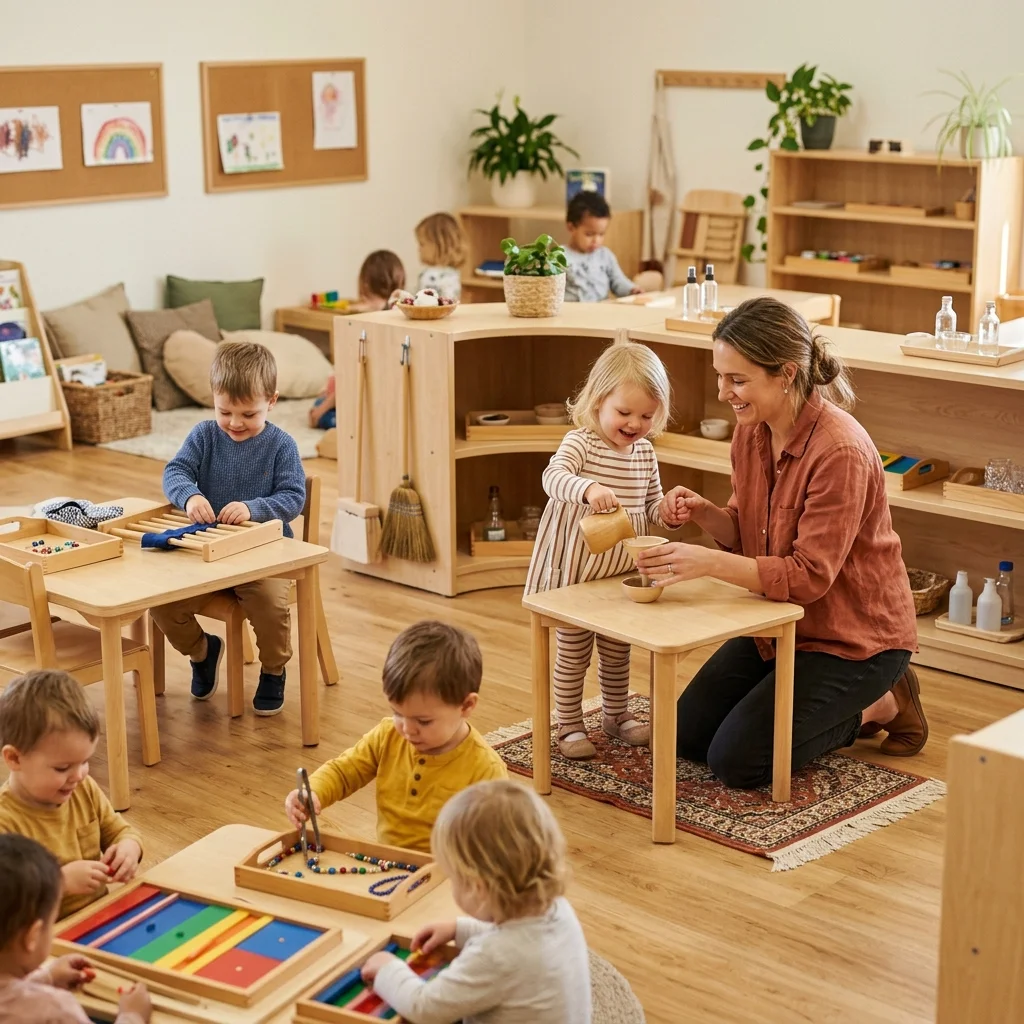
The Montessori practical life curriculum — pouring, folding, buttoning, fastening — develops the fine motor skills children need to manage their clothing independently during toilet visits. These skills are practiced daily, which directly accelerates toilet independence without making it the explicit focus.

05

Mixed-Age Peer Modeling

In Montessori's mixed-age classroom, younger children observe older classmates who are already toilet-independent. This peer modeling is one of the most powerful influences on a toddler's motivation to achieve independence — more effective than adult instruction alone. Children learn from wanting to be like the big kids.

06

Home-School Consistency

Teachers communicate regularly with families about what they observe — when a child initiates independently, what works, what to try at home. Consistency between school and home is the most important factor in successful toilet independence. We make that partnership easy and practical.

Montessori teacher calmly supporting a toddler's practical life independence in a warm classroom
Montessori vs. Traditional Preschool

Why most preschools say no — and why we don't.

Traditional preschools require toilet independence because their classroom design, teacher ratios, and daily schedules don't accommodate the time and support a child in training needs. Requiring it is a systems problem disguised as a readiness requirement.

Montessori Academy's prepared environment is built differently. Child-sized bathrooms, generous teacher ratios, flexible transition times, and a philosophy of meeting the child where they are make it possible — and easy — to accept children across the toilet independence spectrum.

No enrollment barrier. Potty training status does not affect enrollment eligibility at any Montessori Academy campus.

No timeline pressure. We do not give families a deadline for toilet independence. We support the child's developmental pace.

No shame-based practices. Accidents are responded to calmly and privately. Children's dignity is non-negotiable.

Faster results. Most children in Montessori environments achieve toilet independence faster than peers in traditional settings — because the environment is built to support it.

What to Bring

What to pack for your child during the training process.

A simple daily bag makes transitions smooth for everyone.

3–4 complete changes of clothing Including shirt, pants, underwear/training pants, and socks. Label everything with your child's name.
Training pants or underwear (preferred over pull-ups) Montessori philosophy prefers cloth that helps children feel wetness and develop bodily awareness. We'll work with your family on what's right for your child.
A sealable bag for wet clothes We'll send wet clothing home in a sealed bag at pickup. A reusable zip bag keeps things tidy.
Communication log or notes from home If your child had a good morning or showed particular readiness at home, let us know — we'll build on it during the school day.
FAQ

Your potty training questions, answered.

Yes. Montessori Academy accepts children who are not yet potty trained at all three campuses — Culver City, West Adams, and Downey. We do not require toilet independence as a condition of enrollment. Our prepared environment naturally supports toilet training without pressure or shame.
Montessori's approach is rooted in the practical life curriculum. Child-sized toilets, child-accessible bathrooms, and a calm, matter-of-fact attitude toward accidents create an environment where children develop independence at their own pace. Teachers respond to accidents without shame or punishment — a core Montessori value that accelerates, not delays, the process.
Most children in Montessori environments achieve consistent toilet independence between 18 months and 3 years. The prepared environment accelerates this process for most children by providing child-sized facilities, consistent routines, and a non-pressured approach. Every child's timeline is respected.
Pack 3–4 complete changes of clothes, training pants or underwear (Montessori philosophy prefers cloth over pull-ups to build bodily awareness), and a sealable bag for wet clothing to come home in. Label everything with your child's name.
Montessori philosophy generally favors underwear or training pants over pull-ups for children who are ready to begin the process, because underwear provides sensory feedback that builds bodily awareness. We work with each family to find the approach that respects both the child's readiness and family preferences.
No. Potty training is not required for enrollment in the Toddler or Primary program at any Montessori Academy campus. We accept children where they are and support their development from there.
Regression is normal during transitions like starting school. Our teachers respond calmly and without judgement. We'll communicate with you about what we observe and coordinate a consistent approach between school and home.
Many traditional preschools require full toilet independence as an enrollment condition or exclude children who have accidents. Montessori Academy does not. We view toilet independence as a developmental milestone, not an admission requirement. Our prepared environment is designed to support it naturally as part of the practical life curriculum.
Yes. Teachers communicate regularly about the toilet independence process — what seems to be working, when your child initiates independently, and what you can reinforce at home. Consistency between school and home is the most important factor in success.
The Toddler program at Culver City and West Adams accepts children from age 2. The Downey campus accepts children from 6 weeks through the infant and toddler program. Diaper changes are a standard part of care for children in the infant and young toddler range — no potty training required.
Your child is ready. We are too.

No prerequisite. No waitlist. Schedule a tour.

Call us or book a free campus tour at Culver City, West Adams, or Downey. We'll answer every question about how we support children during the toilet independence process.

Related Programs

Toddler Program Primary Program Enrollment Options