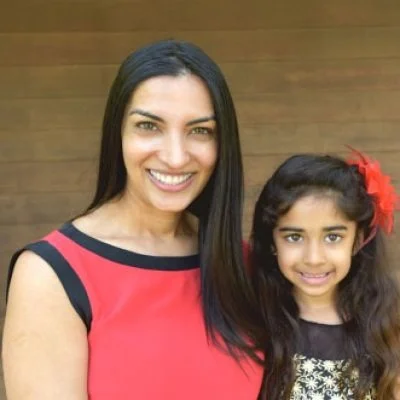
The person behind “Ms. Ruhi”
Ask the parents at pickup and you'll hear her called “Ms. Ruhi” — the name that appears in reviews going back years, usually next to a story about a child who didn't want to leave at 6 PM.
Ruhi first walked through the doors of Montessori Academy not as an administrator, but as a parent. In 2011, her oldest daughter began attending the Culver City school at two years old — and her younger daughter followed, attending the same classrooms a few years later. Both of Ruhi’s daughters grew up at Montessori Academy Culver City. Like so many families before her, she quickly fell in love with the warmth, respect, and beauty of the Montessori environment — first through her daughters’ eyes, then as a daily presence in the school herself.
“Watching my own daughters thrive here — seeing the independence, the curiosity, the love of learning they developed — that’s what convinced me this method works,” she says. “I didn’t just read about Montessori. I lived it as a parent. I saw it change my children. That’s why I believe in it so deeply.”
When the school's owner prepared to retire in 2014, she invited Ruhi to become Director because of her Montessori background and experience. “It was an incredible honor to step into a school that had already become such an important part of my own family's life,” she says. Since then, she has been dedicated to preserving everything families love about Montessori Academy while continuing to grow it for future generations — from one campus to three, with Downey opening in 2023 as the first location to welcome infants and carry children all the way through 3rd grade.
Some of the parents touring today attended these classrooms themselves as children. During tours, Ruhi often watches a parent pause at a familiar Montessori material from their own childhood — they smile, and the memories surface. “Those experiences stayed with them,” she says. “And that's exactly what they hope to give their own children.”
I know you’re trusting us with the most precious person in your life, and that trust is something we never take for granted. The hardest part is often saying goodbye — but it’s usually much harder for the parent than it is for the child. From the moment your child walks through our doors, they become part of our school family.
— Ruhi Khan, on what she tells parents on a child’s first morningMontessori wasn’t something she discovered — it was part of who she wanted to become
Several of Ruhi's aunts were Montessori teachers and school directors, so she spent many of her summer vacations in Montessori classrooms. Even as a young child, she loved helping the younger students. At seven years old, it felt incredibly meaningful to encourage a preschooler, help them learn something new, or simply make them smile.
Those early experiences planted a seed that never left her. From a very young age, she knew she wanted to dedicate her life to Montessori education because she had seen firsthand the confidence, independence, and joy it brings to children.
She pursued her AMI Montessori teacher training through the University of California, Irvine, working simultaneously as a teacher's assistant so she could put everything she was learning into practice every day. She later completed a Master's degree at the Stanford University School of Education, specializing in Learning Design and Technology — a combination that has helped her continually improve the school while always keeping children's needs at the center of every decision.
The boy they said was “too disruptive”
One child will always stay with Ruhi. He joined the school at three years old after attending several other preschools, and his family had been told he was “too disruptive.” When she first met his mother, she was in tears. Like every parent, she simply wanted a place where her child would be understood.
Instead of seeing a disruptive child, the teachers saw a bright, capable little boy who was struggling to communicate what he was feeling. They focused on helping him regulate his emotions, giving him tools to express himself, and allowing him to learn in a way that respected who he was.
As the months went by, something incredible happened. His confidence grew. His communication blossomed. The curiosity and intelligence that had always been inside him finally had the opportunity to shine.
What she believes about how children learn
The biggest misconception Ruhi encounters when families compare free public TK to Montessori is the assumption that all early childhood programs provide the same educational experience. They don't.
“Public TK serves an important purpose, but Montessori is fundamentally different. Every child learns at their own pace, and our teachers carefully observe each student to create lessons that match where they are developmentally — not simply according to their age.”
The years from birth to six are the most important years of brain development. During this time, children naturally absorb language, mathematics, social skills, independence, and problem-solving at an extraordinary rate. Montessori is intentionally designed to make the most of this unique window of learning — and Ruhi encourages families, whenever possible, to continue through age six, because those final years lay a foundation children carry with them for life.
What Ruhi wants families to understand before they see the price
“I understand that tuition is one of the biggest decisions a family makes, and I never take that lightly. When families are considering Montessori, I encourage them to look beyond the price and think about the experience their child will have every single day.”
Your child is surrounded by highly trained Montessori teachers who truly know them as an individual. They carefully observe each child's growth, prepare thoughtful lessons, and create an environment where children feel safe, confident, and excited to learn.
One thing Ruhi is most proud of is the consistency children experience. Many of the teachers have been with Montessori Academy for years because they genuinely love what they do and believe in the Montessori philosophy. That means children build deep, trusting relationships with the adults who care for them every day. “Our school feels like a family, and I believe children feel that sense of belonging from the moment they walk through our doors.”
Parents often ask where graduates go next. The answer is simple: they thrive. Whether they continue into public or private schools, they leave Montessori Academy with a strong academic foundation, a love of learning, and the confidence to succeed.
Insights from a lifetime in Montessori education
Talk to Ruhi
Ruhi reads every enrollment inquiry personally. Reach her at ruhi@montessori-academy.com — or contact your nearest campus directly: